THE ROOFER'S HELPER QUICK LINKS
JOIN 900K+ ROOFING FANS!
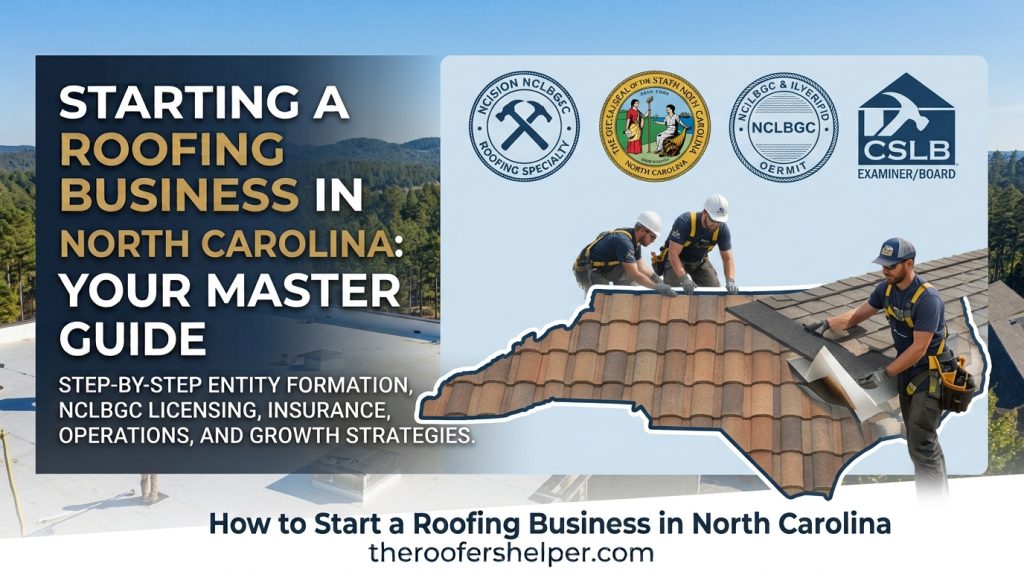
How to Start a Roofing Business in North Carolina
To start a roofing business in North Carolina, follow these core steps:
- Form Your Business Structure: Register an LLC or Corporation with the North Carolina Secretary of State (SOSNC) and obtain a free Federal EIN from the IRS.
- Understand NC License Rules: If undertaking roofing jobs valued at $40,000 or more, obtain a General Contractor License (Building or Roofing Specialty subclass) from the North Carolina Licensing Board for General Contractors (NCLBGC).
- Pass Trade & Law Exams: Pass the PSI general contractor exam, fulfill financial working capital requirements, and post required license bonds.
- Secure Required Insurance: Acquire trade general liability coverage through specialized brokers like Contractors Liability and secure mandatory NC Workers’ Compensation (required for 3+ employees).
- Deploy Contractor CRM Software: Implement field management software like JobNimbus to organize customer estimates, job photo tracking, and crew scheduling.
North Carolina features a rapidly growing housing market and constant exposure to coastal weather systems, creating continuous demand for skilled roofing contractors. However, establishing a successful roofing enterprise in the Tar Heel State requires strict compliance with state licensing laws, financial thresholds, tax registrations, and site safety standards.
Whether you plan to operate in Charlotte, Raleigh, Greensboro, Wilmington, or rural North Carolina communities, this guide outlines the step-by-step roadmap to launch a legal, profitable roofing business.
1. Business Structure & Legal Registration in NC
Setting up your business entity properly insulates your personal finances and establishes legal authority to operate in North Carolina:
- Form an LLC or Corporation: Register your entity with the North Carolina Secretary of State (SOSNC). Forming a Limited Liability Company (LLC) is the most popular choice for contractors because it protects your personal assets from business debt and job-site liabilities.
- File Assumed Name Certificate (DBA): If operating under a trade name different from your registered LLC or legal name, register your Assumed Business Name with the Register of Deeds in your primary county.
- Obtain a Federal EIN: Request a free Employer Identification Number (EIN) on the IRS website to open commercial bank accounts and process crew payroll.
- Open Dedicated Business Banking: Open a commercial checking account to keep all business income, material purchases, and payroll strictly separate from personal funds.
2. North Carolina Roofing Licensing Requirements (NCLBGC)
Understanding North Carolina’s contractor licensing rules is essential before bidding on projects across the state:
The $40,000 Project Threshold
In North Carolina, roofing is regulated under the North Carolina Licensing Board for General Contractors (NCLBGC). If the total cost of a single roofing contract (labor and materials combined) is $40,000 or more, you must hold a valid NC General Contractor License under the Building Contractor or Specialty Roofing classification.
NCLBGC License Classifications & Financial Requirements
The NCLBGC issues licenses across three financial tiers. You must demonstrate specific working capital or net worth to qualify:
- Limited License: Permits individual projects up to $125,000. Requires audited financial proof of $17,000 working capital or $80,000 net worth.
- Intermediate License: Permits individual projects up to $1,000,000. Requires $75,000 working capital.
- Unlimited License: Permits projects of any dollar magnitude. Requires $150,000 working capital.
Exam & Application Process
To acquire your NCLBGC license, you must select a Qualifying Party to pass the NASCLA or PSI Building Contractor exam, submit a background check, provide financial statements reviewed by a CPA, and pay state filing fees.
3. State Tax Registration & Insurance Compliance
Contracting legally in NC requires active tax status and comprehensive trade insurance policy management.
North Carolina Tax Registration
- Register with the North Carolina Department of Revenue (NCDOR) for a sales tax permit if selling taxable materials or secondary products.
- Set up state employer tax accounts for employee income tax withholding and State Unemployment Tax (SUTA).
Mandatory Contractor Insurance
Roofing involves inherent height risks and property damage hazards. Protect your assets with specialized coverage:
- General Liability Insurance: Obtain trade-specific liability policies that cover steep-slope work, open-roof weather damage, and sub-contractor operations. Get custom quotes through Contractors Liability.
- Workers’ Compensation: In North Carolina, any business that regularly employs 3 or more employees (including business owners and corporate officers) is legally required to carry Workers’ Compensation insurance.
4. Tools, Equipment & Field Operations Software
Equipping your crew with standard trade gear and digital workflows streamlines daily operations and prevents costly project delays.
Core Trade Setup Checklist:
- Work trucks or vans equipped with heavy-duty ladder racks
- OSHA-compliant fall arrest harnesses, anchors, and safety ropes
- Extension ladders with ridge hooks and ladder stabilizers
- Pneumatic roofing nailers, air compressors, hoses, and tear-off tools
- Commercial credit accounts with regional distributors (ABC Supply, Beacon, SRS)
Contractor Management Software
Paper invoices and loose estimate sheets lead to lost revenue. You can Try JobNimbus for Free to manage your customer pipeline, order roof measurement reports, send digital proposals, and schedule roof replacements seamlessly.
5. Marketing & Lead Generation in North Carolina
To maintain a high-volume job schedule in competitive markets like Charlotte, Raleigh-Durham, or the NC coast, implement a balanced local marketing plan:
- Claim Google Business Profile: Optimize your business profile for local Map Pack rankings in your target cities. Collect 5-star customer reviews after every completed roof replacement.
- Job-Site Branding: Place branded yard signs on every job site during construction, wrap your work vehicles, and distribute neighborhood door hangers while your crew is on site.
- Storm Restoration & Local Outreach: Build strategic referral partnerships with local insurance adjusters, real estate agents, and home inspectors across your service territory.
- Explore Master Resources: Return to our master guide on How to Start a Roofing Business or read 15 Simple Roofing Marketing Ideas for detailed growth playbooks.