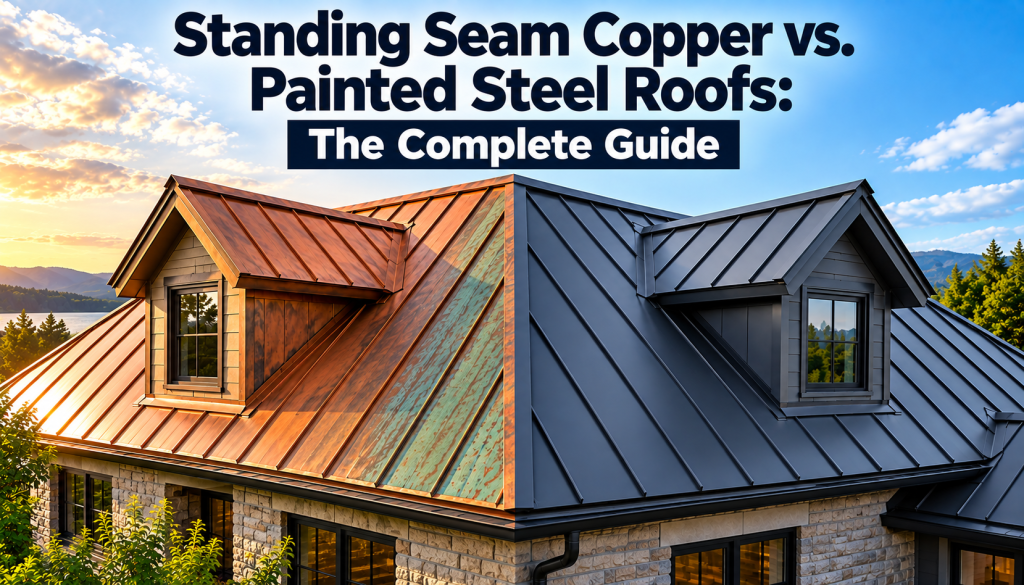
For most homes, a 24-gauge PVDF-painted standing seam steel roof is the smart buy, while copper earns its higher price on historic, high-end, or long-hold properties where a century-scale roof and a living patina are part of the plan.
Both roofs work on the same basic idea: long metal pans joined by raised seams, with the main fasteners hidden underneath. That shared look hides two very different products. Copper is a premium architectural metal that protects itself, ages on purpose, and can outlast the people who paid for it. Painted steel is an engineered, cost-controlled system that delivers a set color, lower price, and wide contractor availability.
This guide is written for two readers at once. Homeowners will find straight answers on cost, lifespan, looks, and warranties. Contractors will find the details that separate a roof that lasts from one that just costs a lot: seams, clips, thermal movement, compatible metals, and specification language.
One theme runs through everything below. The name of the metal matters less than most people think. A beautifully detailed steel roof will beat a poorly detailed copper roof every time, because roofs fail at valleys, flashings, penetrations, and expansion joints, not in the middle of a flat pan.
Copper vs. Painted Steel at a Glance
Copper wins on lifespan, self-protection, and salvage value; steel wins on price, color choice, installer availability, and warranty packaging.
| Factor | Standing seam copper | Painted standing seam steel |
|---|---|---|
| Installed cost (2026 planning) | $25 to $40+ per sq ft | $12 to $22 per sq ft |
| Material package (planning) | About $15 to $25 per sq ft | About $4 to $8 per sq ft |
| Realistic service life | 70 to 100+ years | 40 to 60 years |
| Common residential sheet | 16 oz or 20 oz copper | 24 gauge (sometimes 26 or 22) |
| Metal weight | 1.00 lb/sq ft (16 oz), 1.25 lb/sq ft (20 oz) | Roughly 0.9 to 1.2 lb/sq ft |
| Surface protection | Natural oxide and patina formed by the metal itself | Aluminum-zinc coating plus factory paint (PVDF preferred) |
| Appearance over time | Changes on purpose: bright, then brown, then possibly green | Holds its color, with slow fading and chalking |
| Routine maintenance | Low | Low to moderate |
| Major appearance renewal | Usually never, if you like the patina | Repainting may eventually be wanted |
| Salt coast | Good choice when runoff and adjacent metals are handled | Use caution; confirm a written marine-approved warranty |
| Color choices | Copper and its patina stages | Dozens of factory colors |
| Scrap value | Very high | Recyclable, but far lower value per pound |
| Typical warranty | Material standard plus contractor workmanship | Separate paint, substrate, workmanship, sometimes weather-tightness |
The cost figures are planning ranges, not bids. Roof shape, flashing count, tear-off, deck repair, access, local labor, snow guards, and warranty requirements can push a real quote well outside them.
What Each Roof Costs in 2026
Expect copper to cost at least twice as much as painted steel installed, and more on complicated roofs.
Painted steel
A good residential 24-gauge PVDF standing seam steel roof runs roughly $12 to $22 per square foot of roof surface installed. That excludes major deck rebuilding, complex tear-off, difficult access, and structural work. For reference, the 2025 Cost vs. Value report put a national metal roof replacement at $51,865 for a 30-square roof, or about $17.29 per square foot, right in the middle of that range. That national figure lumps together different substrates, coatings, and profiles, so treat it as a ballpark, not a steel-specific bid.
Copper
Standing seam copper typically lands around $25 to $40+ per square foot installed. Ornate historic work, curved roofs, lots of dormers, custom soldered flashings, and tough access can push it higher. Published 2026 cost guides show copper roofs spanning about $11 to $35 per square foot across all copper roof types, and an earlier standing-seam-specific industry estimate put copper standing seam at $23 to $35.
Copper is also a commodity. It was trading around $6.50 per pound in early October 2026, nearly 30 percent higher than a year earlier, so quotes can shift with the market. Ask how long a copper price is held.
Why copper costs more
It is not only the metal. Copper roofs tend to go on buildings where owners expect hand-formed transitions, soldered details, ornamental work, and tight aesthetic tolerances. That means more bench fabrication and more skilled labor per square. Painted steel gets its value from a thin, strong steel sheet protected by a metallic coating and factory paint, which is efficient to produce and fast to install.
Example budget: 2,000 square feet of roof surface
This is 2,000 square feet of actual roof area, not a 2,000-square-foot house.
| Budget item | Copper standing seam | Painted steel standing seam |
|---|---|---|
| Panel and material package | $30,000 to $50,000 | $8,000 to $16,000 |
| Installed roof | $50,000 to $80,000+ | $24,000 to $44,000 |
| Heavy custom detailing | Can add substantially | Can add substantially |
| First full replacement | Often beyond normal ownership | More likely within a multi-generation hold |
| Appearance renewal | Usually none | Repaint or recoat may eventually be wanted |
Comparing bids the right way
Never compare price per square foot until the scopes match. A $14 steel bid that leaves out tear-off, high-temperature underlayment, ice and water membrane, snow guards, chimney flashing, ridge ventilation, permits, gutters, and deck repair is not cheaper than an $18 bid that includes them. Homeowners should line up bids item by item. Contractors should spell out exactly what is and is not included so their number is not unfairly compared to a stripped-down quote.
Lifespan and Maintenance
Copper is realistically a 70 to 100+ year roof and painted steel a 40 to 60 year roof, but neither one is maintenance-free.
How long they last
Properly detailed architectural copper can reasonably be treated as a multi-generation roof, and premium copper manufacturers describe century-scale service as achievable. That assumes good drainage, compatible accessories, adequate sheet weight, proper allowance for thermal movement, and repairs to flashings and penetrations as they come up. Nobody should promise a homeowner a guaranteed 100 years.
Painted steel depends on a layered protection system: steel, metallic coating, pretreatment, primer, and paint. Drexel Metals cites 40 to 60 years as typical for metal roofs, and the Metal Roofing Alliance cites 50+ years for the category. Harsh salt exposure can shorten that. A well-maintained inland roof can beat it.
What maintenance looks like
Standing seam hides its main panel fasteners, so neither roof needs the recurring screw replacement you see on cheap exposed-fastener panels. Trim, flashings, snow guards, penetrations, and accessories still need regular looks.
For copper, maintenance means:
- Keeping valleys and drainage paths clear
- Checking flashings and penetrations
- Watching for cracked solder or metal fatigue where details are locked in place
- Spotting contact with incompatible metals
If the owner wants patina, do not keep polishing the roof back to bright copper. That just restarts the weathering clock and can leave a blotchy finish.
For painted steel, add attention to:
- Scratches, cut edges, and coating damage
- Early rust spots
- Sealant condition
- Salt or debris buildup (one current Drexel warranty recommends an annual fresh-water rinse in high-salt areas)
Rough maintenance budgets
There is no national database of residential maintenance invoices for these roofs, so treat these as planning numbers:
| Item | Planning allowance |
|---|---|
| Routine professional inspection or service visit | A few hundred dollars on an accessible home |
| Localized flashing or penetration repair | About $500 to a few thousand dollars |
| Future full repaint of a steel roof | Several dollars per sq ft (wash, prep, spot prime, topcoat) |
Copper repair labor often costs more per hour because fewer roofers can fabricate and solder copper properly.
The real cost question: how long will you own it?
Steel’s lower first cost does not mean its paint lasts forever. Copper’s higher first cost does not mean it never needs a repair. The honest comparison is total cost over the ownership period. A homeowner planning to sell in 10 to 20 years will have a very hard time recovering copper’s premium. A family, institution, or historic property holding a building for many decades gets real value from skipping one or more replacement cycles.
How Each Roof Is Built
The panel field may look similar, but copper demands more hand fabrication and roughly 40 percent more allowance for thermal movement than steel.
Seams and panels
Steel standing seam comes in several architectures: snap-lock, mechanically seamed, structural standing seam, and nail-flange or clip-attached architectural panels. Common panel widths run about 12 to 18 inches, with 16 inches very common. Manufacturers such as PAC-CLAD and ATAS offer concealed-fastener systems installed over a solid substrate.
Traditional copper often uses hand-formed or machine-formed single-lock and double-lock seams held with concealed cleats. Copper can be mechanically seamed like steel, but hips, ridges, valleys, dormers, curved sections, and penetrations usually call for bench fabrication, hand folding, soldering, or locked-seam work. That is a big reason copper labor runs higher.
Typical installation sequence
Both roofs start the same way:
- Survey the structure, roof geometry, and local loads
- Verify the deck and substrate
- Install the specified underlayment and ice and water protection
From there, copper typically goes:
- Lay out pans with compatible copper or stainless cleats
- Form the standing seams
- Double-lock or mechanically close the seams
- Fabricate copper flashings, valleys, and penetration details
- Build in movement joints and compatible-metal details
And painted steel typically goes:
- Lay out factory-formed or site-roll-formed panels
- Install tested clips or the concealed fastening flange
- Snap or mechanically seam the panels
- Install manufacturer-compatible trims, closures, and sealants
- Protect paint, cut edges, and drainage paths
Both finish with a final inspection of seams, drainage, and penetrations.
Clips and fasteners
“Concealed fasteners” is not a specification. The contractor needs the actual clip or flange design, the substrate fastener, pull-out capacity, clip spacing, edge and corner requirements, panel width, seam height, and the test basis for wind uplift. The Metal Construction Association calls fastener selection critical to both holding power and watertightness. Wind performance belongs to the tested assembly, not to “copper” or “24-gauge steel” by themselves.
With copper, every cleat and fastener must be compatible with copper. Copper contact or copper runoff speeds up corrosion of less noble metals like galvanized steel and aluminum. This is real enough that Drexel’s steel warranty specifically excludes damage from copper or lead runoff and contact.
Deck and substrate
Residential architectural standing seam usually goes over a continuous deck. Structural standing seam steel can be engineered over spaced purlins, but a homeowner should not assume a deckless agricultural-style panel is the same thing as an architectural roof. Copper performs best over a smooth, continuous substrate that supports the soft sheet and lets it move.
Underlayment and insulation
The metal sheds the water. The underlayment is backup, during construction and after any unusual leak. It must be rated for the high temperatures under metal roofing and approved by the panel manufacturer. Ice and water membrane at eaves and other vulnerable areas depends on climate and code. Traditional copper specs often add a slip sheet between the copper and underlayment to reduce sticking and abrasion, though some modern assemblies use approved alternatives. The NRCA Roofing Manual and the manufacturer’s tested details should govern, not a generic detail found online.
Spray foam applied directly to the underside of some metal panels can lock them in place, restricting thermal movement and contributing to oil canning or distortion. Get the panel manufacturer’s approval first.
Thermal movement: the big copper issue
Copper expands roughly 16.5 to 17 micrometers per meter per degree Celsius, compared with about 11.5 to 12 for carbon steel. In plain terms, copper moves about 40 percent more than steel over the same length and temperature change.
Example: a 50-foot panel through a 100°F temperature swing.
| Metal | Approximate free movement over 50 ft |
|---|---|
| Copper | 0.55 in |
| Carbon steel | 0.39 in |
That is enough to tear seams, slots, fasteners, penetrations, and flashings if the system is locked down. Long runs need a defined fixed point plus clips or details that allow movement everywhere else. Allowable panel lengths and expansion details must come from the panel system or copper design standard, not from this rough math.
Contractor note: A “floating clip” alone does not make a long panel safe. Verify the clip’s actual travel, the expected metal temperature range, the installation temperature, where the fixed point sits, the splice strategy, ridge and eave terminations, and movement at penetrations. A panel can float perfectly and still fail where a pipe curb or valley pins it.
Weight
Weight is surprisingly close. Sixteen-ounce copper weighs about 1.0 lb per square foot and 20-ounce copper about 1.25. Typical residential painted steel is in the same one-pound class depending on gauge and profile. So dead load rarely decides between them. Deck condition, fastener pull-out, wind zones, snow load, existing roof layers, snow guard loads, and aging framing matter far more. Bring in a structural engineer when conditions are unusual or marginal.
How Each Roof Weathers and Ages
Copper is designed to change color over decades; painted steel is designed to resist change and slowly loses that fight.
Copper’s patina
Fresh copper reacts with the air and builds layers of oxides and copper salts that protect the metal underneath. Instead of relying on paint to hold one look, the surface itself evolves. The bright salmon color at installation is temporary, and that change is a feature, not a defect.
Nobody can promise a patina schedule. Air pollution, salt, rainfall, humidity, roof orientation, runoff paths, and local microclimate can shift it by decades. A sheltered dormer and a rain-washed, ocean-facing slope on the same house can look completely different. A typical progression looks like this:
| Age | Natural copper | PVDF painted steel |
|---|---|---|
| Installation | Bright salmon or orange copper | Uniform factory color and gloss |
| First months to a few years | Tan, russet, and brown | Little visible change on quality PVDF |
| Several years | Dark brown, often mottled | Little visible change |
| Roughly 5 to 20+ years | Green or blue-green may start, faster in marine or humid urban air | Gradual gloss loss, fading, and chalking become measurable (10 to 25 years) |
| 20 to 30+ years | Green can dominate in favorable climates; dry rural sites may take much longer | Aesthetic repaint may be worth considering (25 to 40+ years) |
| Later life | Stable patina | Coating renewal and spot corrosion control matter more |
Do not tell a customer “it will be green in ten years.” If an owner needs green from day one, specify a factory pre-patinated product instead of promising natural weathering.
Painted steel’s finish
Premium architectural steel usually uses a PVDF (polyvinylidene fluoride) coil coating, applied to flat sheet at the factory before forming. PVDF is chosen for strong resistance to UV, oxidation, humidity, and temperature extremes. Drexel, for example, backs its PVDF system with a 35-year limited finish warranty.
Three different kinds of paint aging matter:
| What happens | What the homeowner sees | What it means technically |
|---|---|---|
| Fading | Color drifts from the original | Pigment and coating change, measured as color difference |
| Chalking | Powdery, often whitish film; dull color | The paint binder breaks down and leaves pigment at the surface |
| Film failure | Cracking, flaking, peeling | The coating has lost integrity; more serious than fade |
Warranties measure fade with ASTM D2244 and chalking with ASTM D4214. That is why a 35-year paint warranty does not mean the roof looks brand new for 35 years. It means fade and chalk stay under defined limits.
There is no universal “repaint every 20 years” rule. A light PVDF color in moderate exposure can look fine past 30 years. A deep, saturated color under harsh sun or salt may need attention sooner. Repaint based on condition, and make sure the new coating is compatible with and properly bonded to the aged factory finish.
Climate and Region
The right answer shifts most near salt water, where steel warranties get strict, and in hot climates, where light painted colors win on reflectance.
| Climate | Copper | Painted steel | Design priority |
|---|---|---|---|
| Immediate coast / salt spray | Strong atmospheric durability; handle runoff and dissimilar metals carefully | Highest caution; generic warranties may exclude marine sites | Get a written coastal warranty before buying |
| Snow country | Excellent with correct seams and snow retention | Excellent with engineered clips and snow retention | Snow slides, ice dams, snow guard loads |
| Hot / high sun | Durable, but not chosen for solar reflectance | Strong, especially light high-reflectance colors | SRI, attic insulation, movement |
| Humid / rainy | Excellent if drainage prevents ponding and underside moisture | Good; watch condensation and coating defects | Ventilation, air and vapor control, dry deck |
| Freeze-thaw | Very good | Very good | Flashings, drainage, ice dams |
| High wind / hurricane | Excellent only as a tested, engineered assembly | Excellent with tested clips and seam system | ASTM/UL/FM tested assembly, edge-zone attachment |
Coastal homes
“Metal is great at the beach” is not good enough. One current Drexel PVDF/Galvalume warranty uses example minimum distances of about 2,800 feet from surf, 1,200 feet from a large bay, and 600 feet from a marsh or canal. Those are one manufacturer’s warranty conditions, not code, but they show how much salt affects steel coverage. The Metal Construction Association has documented coastal projects where aluminum was picked over steel specifically for saltwater resistance. If the house is close to salt water, get written, address-specific approval from both the coil coater and the panel manufacturer. Copper is usually more tolerant, but its fasteners, flashings, gutters, and runoff destinations still need compatible design.
Snow country
Standing seam is a natural fit for snow because the seams and fasteners sit above the water path. The flip side is that smooth metal can dump big sheets of snow all at once. Entrances, walkways, lower roofs, mechanical equipment, and gutters may need engineered snow retention. Size the snow guards and their attachment to the actual snow load.
Hot climates
If energy performance matters, painted steel gives an easy path to a high-reflectance roof because manufacturers publish solar reflectance and SRI values for each color. Copper handles heat well, but natural copper should not be sold as a “cool roof” without actual test data.
Humid climates
Condensation under the panels can ruin an otherwise excellent roof. Wet insulation and trapped moisture are specifically called out in metal roof warranties. Design air sealing, vapor control, ventilation, insulation, and underlayment as one system.
Understanding the Warranties
A paint warranty, a substrate warranty, a workmanship warranty, and a weather-tightness warranty are four different things, and a proposal that just says “35-year warranty” tells you almost nothing.
Painted steel warranties
A current Drexel example offers 35 years of limited PVDF paint coverage and 25 years of Galvalume substrate coverage. It covers film integrity, fade, chalking, and substrate corrosion against defined ASTM measurements. Exclusions include:
- Abrasion and scratching
- Standing water and areas rain cannot naturally wash
- Aggressive salt or chemical environments, and some coastal locations
- Corrosive internal condensation and wet materials
- Dissimilar-metal contact and copper or lead runoff
- Installation-related conditions
In its standard form it also does not promise to pay all the labor involved in a repair. Meanwhile, the installation itself may carry a much shorter contractor workmanship warranty. Some qualified programs offer separate premium or weather-tightness coverage.
Copper warranties
Copper has no factory paint, so there is no color warranty to sell. ASTM B370 defines the sheet material, but patina color and timing are not something anyone warrants. On a custom copper roof, the contractor’s workmanship coverage and the quality of the project detailing matter far more than any marketing warranty.
What homeowners should do
Ask for the actual warranty documents before signing. Find out who backs each piece (manufacturer, coater, or installer), for how long, what is excluded, whether labor is covered, and whether your specific address qualifies.
Recycling, Environmental Impact, and Resale
Both metals recycle well, neither is a clear environmental winner on paper, and no national data shows copper returning a specific extra percentage at resale.
Recycling and environment
The Metal Roofing Alliance notes that metal roofing is recyclable at end of life and that many metal roofs contain at least 25 percent recycled content. Copper is highly recyclable too, and its high scrap value gives everyone a strong reason to recover it.
Calling either metal “greener” just because it recycles is misleading. A fair comparison looks at mining, refining, steelmaking, rolling, coating chemistry, shipping, installation waste, service life, maintenance, replacement frequency, and end-of-life recovery. Product-specific Environmental Product Declarations (EPDs) are more useful than sustainability slogans.
Copper’s case gets stronger when it actually delivers many decades of service and then gets recycled. Steel’s strengths are efficient use of a small amount of metal, massive recycling infrastructure, lower material cost, and the option to extend service by recoating sound panels instead of replacing them.
Resale value
The 2025 Cost vs. Value data put a standard metal roof replacement at about $51,865 in cost and $25,972 in estimated resale value, roughly a 50 percent recoup. That does not mean a metal roof “loses half its money.” It captures estimated value at sale, not decades of avoided replacements. And it does not separate copper from painted steel, so there is no credible basis for claiming copper adds a specific percentage at resale.
Copper’s resale edge is real but qualitative. On a historic home, a landmark, a luxury traditional house, a high-end coastal property, or an architect-designed project where copper is part of the design, it can set the home apart. On a typical suburban house, buyers may admire it without paying enough extra to cover the premium. Painted steel’s wide color range fits contemporary, farmhouse, mountain, industrial, and traditional homes without asking a buyer to love green patina.
One simple question helps: does the owner want the roof to change? Copper is a living finish. Someone who loves the bright penny color but dislikes brown or green should not buy natural copper. Painted steel is built to hold its look.
Which Roof Is Right for You?
Match the roof to the owner’s priorities: budget and color control point to steel, while longevity, patina, and historic character point to copper.
Scorecard
Scores run 1 to 5, with 5 most favorable. They are decision aids, not lab grades.
| Priority | Copper | Painted PVDF steel | Edge and why |
|---|---|---|---|
| Lowest first cost | 1 | 5 | Steel, by a wide margin |
| 10 to 20 year ownership | 2 | 5 | Hard to recover copper’s premium in a short hold |
| 40 to 60 year durability | 5 | 5 | Both, when well detailed |
| Maximum possible service life | 5 | 4 | Copper has the stronger century-scale case |
| Least reliance on applied coating | 5 | 2 | Copper protects itself |
| Factory color selection | 1 | 5 | Steel offers many colors |
| Long-term color consistency | 1 | 4 | Copper changes on purpose |
| Natural patina character | 5 | 1 | Copper is unique |
| Avoiding appearance renewal | 5 | 3 | Steel may eventually need repainting |
| Finding qualified installers | 2 to 3 | 5 | Skilled copper crews are scarce |
| Complex ornamental work | 5 | 3 | Copper is very workable |
| Immediate salt-spray exposure | 4 | 2 | Copper usually; verify every detail |
| High solar-reflectance color | 2 to 3 | 5 | Light PVDF colors with tested SRI |
| Recycling and salvage incentive | 5 | 4 | Both recycle; copper’s scrap value is far higher |
| Historic authenticity | 5 | 2 to 4 | Depends on the building’s era and preservation rules |
| Predictable warranty package | 3 | 5 | Steel makers publish finish and substrate programs |
Quick guide by owner type
Budget-driven homeowner: Painted steel, clearly. Specify a reputable standing seam system, 24-gauge for premium residential work unless engineering supports otherwise, PVDF where color retention matters, and written substrate and finish warranties that apply to your address.
Longevity-driven owner: Copper makes sense when the roof will realistically stay on the building for generations. Be ready to pay for skilled copper fabrication at valleys, parapets, chimneys, penetrations, and transitions. Do not spend big on copper sheet and then cut corners on labor.
Aesthetics-driven owner: Decide whether the look should stay put or evolve. Copper for a warm, changing, architectural surface. Steel for a specific charcoal, bronze, gray, red, green, white, or other set color.
Low-maintenance owner: Copper has a slight long-run edge since there is no paint to renew. Neither is maintenance-free; drainage, flashings, seams, penetrations, sealants, storm damage, and snow guards still need checking.
Coastal homeowner: Get the exact coating and substrate warranty for your address in writing. Steel warranties can carry explicit salt-water distance limits. Copper is often more forgiving, but adjacent metals, gutters, and runoff still need compatible design.
Snow-country contractor: Focus on the assembly: deck, ice and water protection, seam type, clip capacity, snow load, snow guard attachment, and safe places for sliding snow to land.
Hot-climate project: Painted steel offers the easiest route to a high-reflectance roof using published SRI values.
Humid building: Do not let rain resistance distract from interior moisture. Design air leakage, vapor drive, ventilation, insulation, and underlayment as a system, and get manufacturer approval for any foam against the panel.
For Contractors: Specification Checklists
“Standing seam metal roof” is not a specification; each checklist below covers what a defensible spec should name.
Painted steel spec should identify
- ☐ Substrate standard (ASTM A792/A792M aluminum-zinc coated steel)
- ☐ Gauge or minimum thickness
- ☐ Metallic coating
- ☐ Paint chemistry (PVDF vs. SMP) and color
- ☐ Seam profile and height, panel width
- ☐ Clip type and spacing
- ☐ Substrate and underlayment
- ☐ Fastener type
- ☐ Wind uplift test basis
- ☐ Minimum slope
- ☐ Flashing material and sealants
- ☐ Thermal movement strategy
- ☐ Snow retention, if applicable
- ☐ Each applicable warranty (paint, substrate, workmanship, weather-tightness)
Copper spec should identify
- ☐ ASTM B370 sheet, ounce weight, and temper where relevant
- ☐ Panel width and seam configuration
- ☐ Cleat material and spacing
- ☐ Fixed and moving zones, expansion provisions
- ☐ Substrate and underlayment or slip sheet
- ☐ Valley design
- ☐ Solder type and locations
- ☐ Flashing geometry
- ☐ Compatible fasteners and isolation from adjacent metals
- ☐ Runoff management
- ☐ Workmanship requirements
Baselines used in this guide
The steel discussed here is a premium residential system: roughly 24-gauge aluminum-zinc coated steel with a PVDF finish. Cheaper 26-gauge or SMP-painted systems and heavier 22-gauge products exist, but swapping them changes dent resistance, structure, price, color retention, and warranty.
The copper discussed here is natural, uncoated 16- or 20-ounce architectural copper. Pre-patinated copper, lead-coated copper, copper shingles, and copper-coated steel behave differently.
Cost figures assume a detached U.S. home with reasonable access and conventional roof geometry. They exclude major framing repair, full deck replacement, hazardous material abatement, crane work, historic documentation, complex ornamental fabrication, and unusually high local labor. Patina timelines and maintenance allowances are planning guidance, not warranties. Manufacturer requirements and an experienced local sheet metal contractor should always override generic numbers.
The Bottom Line
Choose painted PVDF standing seam steel for the best balance of price, durability, predictable color, installer availability, and warranty coverage. Choose standing seam copper when the architecture benefits from a living metal finish, the owner values a potential century-scale roof, and the budget covers both premium sheet and premium craftsmanship.
Either way, the difference between an expensive metal roof and a truly durable one comes down to seams, clips, flashings, drainage, thermal movement, and moisture control as much as the metal itself. Hire the installer for the details, not just the material.
Further Reading
These references are worth consulting, roughly in order of priority, for anyone writing a specification:
| Source | Why it matters |
|---|---|
| ASTM B370, Copper Sheet and Strip for Building Construction | The primary U.S. standard for architectural copper sheet |
| ASTM A792/A792M, Aluminum-Zinc Alloy-Coated Steel Sheet | The primary standard for common aluminum-zinc coated steel substrates |
| NRCA Roofing Manual | Roof system design, installation, codes, and details |
| Copper Development Association, Copper in Architecture | Copper roofing, flashing, patina, and detailing guidance |
| Metal Construction Association | Steel properties, fasteners, sealants, and panel behavior |
| Sherwin-Williams PVDF Coatings Guide | How PVDF coil finishes work and perform |
| Drexel Metals Finish Warranty | Real-world 35-year PVDF and 25-year Galvalume warranty terms and exclusions |
| PAC-CLAD, ATAS, and McElroy Metal standing seam literature | Manufacturer gauge, substrate, clip, and installation requirements |
| International Copper Association | Copper lifecycle and sustainability |
| Metal Roofing Alliance | Metal roof longevity, recycled content, and recycling |
| This Old House, Copper Roof Cost (2026) | Consumer-level copper cost benchmark |
| Zonda Cost vs. Value | National remodeling cost and resale benchmarks |