Asbestos roof tiles, also called asbestos-cement shingles, are still on thousands of older homes, garages, and barns across the country. They were sold for most of the 20th century as an affordable, fireproof stand-in for slate, and they did the job so well that many people today don’t realize what’s on their roof.
The word “asbestos” scares people, and that’s understandable. But an intact asbestos tile roof is usually far less of a threat than people fear. Knowing what you actually have changes how you repair it, what it’s worth, and how careful you need to be.
This guide covers where asbestos roof tiles came from, how long they last, why they usually aren’t cause for panic, how to tell if your roof has them, and how to tell them apart from natural slate.
A brief history of asbestos roof tiles
Asbestos-cement shingles were invented to be cheaper than slate, lighter than clay tile, and fireproof. They did all three well, which is why so many are still on roofs today.
The invention. Around 1900, Austrian businessman Ludwig Hatschek worked out how to press a mix of Portland cement and asbestos fibers into thin, strong sheets. The recipe was roughly 90% cement and 10% asbestos. He spent years trying to create a roofing material that was fire-resistant, lighter than fired clay tile, and cheaper than slate. In 1903 he named it “Eternit,” from the Latin word for eternal.
Arrival in America. Hatschek’s patent was reissued in the United States in 1907, and production took off. Within about a decade, Eternit factories were operating across Europe and in the U.S. and Canada. Big American makers followed, including Johns-Manville and the Asbestos Shingle, Slate & Sheathing Company of Ambler, Pennsylvania.
The boom years. Manufacturers openly marketed these shingles as a substitute for slate, wood, and clay. They could be punched and trimmed on site, and roofers installed them much like slate. Fire safety helped sales: the National Board of Fire Underwriters recommended asbestos-cement roofing in 1920. Common patterns included American (rectangular), Dutch Lap, and French or hexagonal (diamond-shaped) layouts.
The decline. As the health dangers of asbestos became clear, demand fell. U.S. production of asbestos-cement shingles and siding wound down by the 1980s. In 2024 the EPA finalized a ban on chrysotile asbestos, the last type still used in the country; by then it was no longer used in roofing.
What this means for you. A North American home built or reroofed between about 1910 and 1980 with gray, uniform “slate-like” shingles is a strong asbestos-cement candidate.
Natural slate: the material asbestos tiles imitated
Natural slate is real stone, split by hand from quarried rock, and a good slate roof can outlast the house it sits on.
Slate forms when fine clay and silt are squeezed and heated deep underground over millions of years. The result is a dense rock that splits cleanly into thin, flat sheets along natural layers. Quarry workers split blocks into individual shingles, then trim the edges by hand.
In the U.S., major slate regions include Pennsylvania’s Slate Belt (around Bangor and Pen Argyl), the Vermont–New York slate valley, Virginia, and Maine. Slate is also imported from Spain, Wales, China, and Brazil. Colors range from gray and blue-black to green, purple, red, and mottled blends.
Roofers often sort slate into two broad groups. “Soft” slates (many Pennsylvania slates) commonly last 60 to 125 years. “Hard” slates (many Vermont, Virginia, and Maine slates) can last 100 to 200 years or more. Either way, the slate itself usually outlives the nails and flashing holding it.
How long asbestos roof tiles last (and how slate compares)
Both materials last a long time, but natural slate generally wins by decades. Asbestos-cement still earned its “eternal” name better than most people expect.
Asbestos-cement shingles commonly last 50 to 80 years, and many original roofs from the 1920s through the 1950s are still doing their job. They don’t rot, burn, or attract insects. Their weaknesses are:
- Brittleness. They crack easily under foot traffic, hail, falling branches, or a careless ladder.
- Surface wear. Over decades the surface weathers, color fades, and the face can turn chalky or rough.
- Moss and lichen. Growth holds moisture and slowly roughens the surface.
- No new replacements. Matching shingles haven’t been made in decades, so repairs rely on salvaged pieces or look-alike substitutes.
Natural slate commonly lasts 75 to 150+ years, depending on its quality. It’s fireproof, highly water-resistant, and holds its color. Its weaknesses are:
- Weight. Slate is heavy and needs a framing structure that can carry it.
- Breakage. It can crack when walked on improperly or hit hard.
- Delamination. Lower-grade or soft slate can eventually flake and split into layers.
- Fasteners and flashing. Nails and metal flashing often fail before the stone does.
The bottom line: an asbestos-cement roof in decent shape may still have years left. A quality slate roof, properly maintained, may still have a century left.
Should you worry about asbestos tiles on your roof?
In most cases, no. An intact asbestos-cement roof that’s left alone is generally considered low risk to the people living under it.
Why the risk is low. Asbestos causes harm when its microscopic fibers get into the air and are breathed in. In these shingles, the fibers are locked inside hard cement. Regulators classify this kind of product as “non-friable,” meaning it can’t be crumbled to powder by hand. As long as the shingles aren’t being broken, cut, or ground, very few fibers are released.
Keep some perspective. The serious asbestos diseases, such as mesothelioma and asbestosis, are tied mainly to heavy, repeated exposure. Think of factory workers, insulation installers, and shipyard crews breathing airborne fibers day after day for years. Living under a sound asbestos-cement roof is a very different situation.
Many experts recommend leaving it alone. If the shingles are in good shape, the standard advice is to leave them undisturbed rather than tear them off. Removal is actually the moment of greatest fiber release.
When to be careful. The risk goes up when the material is disturbed. Avoid these:
- Cutting, drilling, sanding, or grinding the shingles, especially with power tools
- Pressure washing, which can blast loose surface fibers
- Walking carelessly across the roof and cracking shingles
- Breaking shingles during removal instead of taking them off whole
- Letting badly crumbling, heavily weathered shingles go unattended
For contractors. Treat these shingles as asbestos-containing until a lab says otherwise. Keep them wet when working, remove them whole, bag or wrap them, and follow your state and local disposal rules. Many states require licensing or notification for contractors who remove asbestos material. Federal OSHA rules treat removal of asbestos roofing shingles as Class II asbestos work for employers, with training and work-practice requirements. Check with your state environmental or health agency and your local building department before starting a tear-off.
Is my roof asbestos tiles?
If your roof checks several of the boxes below, treat it as asbestos until a lab test says otherwise. You can check most of these from the ground, so there’s no need to climb up.
- The roof dates from about 1910 to 1980. That’s the main era for asbestos-cement roofing in the U.S. A newer roof is less likely, but an older house can still have an original roof, and records aren’t always reliable.
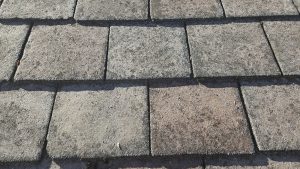
- The tiles look factory-made. Every piece is the same size, the same thin thickness, and has the same straight edges.
- The pattern is diamond, hexagon, or “honeycomb.” These French-style layouts were very common with asbestos tiles and rare with real slate. Asbestos tiles can also be rectangle or other shapes.
- The surface has a stamped texture that repeats from tile to tile, such as a stipple or fake wood grain.
- The color is gray or faded red, green, or blue-black, often uneven or chalky with age.
- The bottom corners are held with exposed metal clips, common on Dutch Lap asbestos roofs.
- The house has matching stiff, gray cement siding with a stamped wood-grain or stippled face.
- A fallen or loose piece shows a maker’s stamp such as Johns-Manville, Keasbey & Mattison, Ruberoid, CertainTeed, National Gypsum, or Flintkote.
Look-alikes to keep in mind. Several newer products can be mistaken for asbestos tiles:
- Modern fiber-cement shingles look very similar but use non-asbestos fibers. They’re common on roofs installed since the late 1980s.
- Synthetic or composite slate is made of rubber, plastic, or recycled materials. It’s light and often slightly flexible.
- Concrete roof tiles are much thicker and heavier, and usually interlock or sit on battens.
- Natural slate is the most common mix-up, covered in the next two sections.
When you need to know for sure. If the roof is intact and you aren’t planning any work, you may not need to test right away. Testing becomes important before reroofing, solar installation, chimney or dormer work, storm repairs, or selling the house. In those cases, have a trained inspector take a sample for lab analysis.
Is my roof asbestos or natural slate? What to look for
The biggest giveaway is uniformity. Factory-made asbestos-cement shingles look identical; hand-split slate never does. You can check most of these from the ground with binoculars.
- Shape and layout. Diamond, hexagonal, or “honeycomb” patterns are a strong sign of asbestos-cement. Slate is almost always laid in plain rectangles (sometimes with fancy cut ends like fishscale).
- Uniform size and thickness. Asbestos-cement shingles are all the same size and the same thin thickness, usually about 3/16 inch. Slate varies a little from piece to piece, and the butt edges look uneven up close.
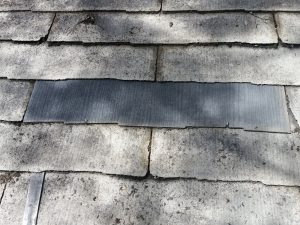
- Edges. Slate edges are hand-trimmed, leaving a chipped, beveled edge. Asbestos-cement edges are straight, crisp, and machine-cut.
- Surface texture. Asbestos-cement often has a stamped, repeating texture, like a stippled or fake wood-grain pattern. Slate has a natural, slightly wavy split face that never repeats.
- Nail holes. Asbestos-cement shingles have factory-punched holes that sit in the same spot on every piece. Slate holes are punched by hand, so their placement varies, and the back side is often chipped out around the hole.
- Color and weathering. Asbestos-cement is usually gray, or colored with pigment (red, green, blue-black) that fades unevenly over time. The surface can turn chalky. Slate holds its natural color for decades, though some “weathering” slates change shade gradually.
- Corner clips. Exposed metal clips or “clinchers” holding the bottom corners are common on Dutch Lap asbestos-cement roofs and rare on slate.
More ways to tell asbestos tiles from slate
If looking isn’t enough, a loose or already-broken piece tells you a lot. Don’t break a shingle just to check it; use one that has already fallen or cracked.
- The broken edge. Slate breaks along its layers, so a broken edge looks flaky or stepped, like the pages of a book. Asbestos-cement shows a gray, gritty, cement-like core that’s the same all the way through. Sometimes you can see tiny fibers.
- The back side and manufacturer stamps. Slate’s back looks much like its front: natural split stone. Asbestos-cement backs are often smoother or textured differently, and some carry a maker’s stamp or mark. Names you may find include Johns-Manville, Keasbey & Mattison (often sold as “Century” shingles), Ruberoid, CertainTeed, National Gypsum (Gold Bond), and Flintkote. A stamp is a strong clue, but many shingles have none, and a stamp alone doesn’t prove asbestos content.
- The siding. Houses with asbestos-cement roofs often have matching asbestos-cement siding: stiff, flat or wavy-edged panels about 12 by 24 inches, often with a stamped wood-grain or stippled face. If the siding fits that description, the roof is more likely asbestos-cement too, and the siding deserves the same care.
- Weight. Slate is noticeably heavier. The National Slate Association puts standard 1/4-inch slate at about 935 pounds per square (100 sq ft), and thicker slate weighs more. Asbestos-cement shingles are much thinner and lighter, though weight alone can’t tell you whether asbestos is present.
- The sound. Experienced slaters tap loose slates to judge their condition; good slate often rings, while weathered slate can thud. Asbestos-cement can also give a hard, almost ceramic sound. Because the results overlap, sound is a weak clue, and it’s never a reason to climb onto a suspect roof.
- The home’s history. A roof installed between about 1910 and 1980 with uniform, slate-like shingles leans toward asbestos-cement. Old receipts, permits, or the original builder’s records can help.
The only sure answer is a lab test. No visual or hands-on check can prove whether asbestos is present, especially since newer non-asbestos fiber-cement and synthetic slate can look similar. Have a trained asbestos inspector take the sample, since sampling itself can release fibers and roofs add a fall risk. The sample goes to an accredited lab, which uses a microscope test called polarized light microscopy (PLM). Results usually come back in a few days and cost far less than the roof work you’re planning. If you can, hire an inspector who isn’t connected to the company that would do the removal.
Asbestos tiles vs. natural slate at a glance
Use this as a cheat sheet on the roof or at the kitchen table.
| Feature | Asbestos-cement shingles | Natural slate |
|---|---|---|
| What it is | Factory-made cement with asbestos fibers | Natural stone split from a quarry |
| Years made / used | About 1907 to the 1980s in the U.S. | Centuries; still quarried today |
| Typical lifespan | 50 to 80 years | 75 to 150+ years |
| Shapes | Rectangles, diamonds, hexagons, Dutch Lap | Mostly rectangles, some fancy cut ends |
| Size and thickness | Identical, thin (about 3/16 in.) | Slight variation piece to piece |
| Edges | Straight, machine-cut | Chipped, hand-beveled |
| Surface | Often stamped, repeating texture | Natural split face, never repeats |
| Nail holes | Factory-punched, same spot every piece | Hand-punched, chipped out on back |
| Broken edge | Gray, gritty, uniform core | Layered, flaky, like book pages |
| Tap sound | Can ring or thud; unreliable | Often rings; weathered slate may thud |
| Weight per square | About 250 to 500 lb | About 700 to 1,000+ lb |
| Main concern | Fiber release if broken, cut or removed | Weight and broken pieces |
| Replacements | Salvaged or look-alike only | New and salvaged slate available |
Your options: repair, replace, or leave it alone
If your asbestos-cement roof is mostly sound, leaving it in place and repairing it as needed is usually the smartest and safest choice.
- Leave it alone. Keep foot traffic off it, keep gutters clean, and skip the pressure washer. Inspect it from the ground every year or after storms.
- Spot repairs. A roofer experienced with slate-style roofs can swap out cracked shingles one at a time, using a slate ripper and slate hooks or copper nail-and-bib repairs. Replacements can be salvaged asbestos-cement, non-asbestos fiber-cement, or a carefully matched slate or synthetic.
- Full replacement. When the roof is widely cracked, crumbling, or leaking, it may be time to replace it. Hire a contractor who knows asbestos rules in your state, and expect the shingles to be removed whole, kept wet, wrapped, and disposed of properly. Many owners choose natural slate, synthetic slate, or architectural shingles as the new roof.
Whatever you have overhead, the main rule is simple: if you don’t know what it is, treat it as asbestos until a lab says otherwise. An intact asbestos-cement roof isn’t something to lose sleep over. It’s something to handle with respect.
Frequently asked questions
Is my “slate” roof actually asbestos?
It might be. If the shingles are perfectly uniform, thin, machine-edged, or laid in a diamond or hexagon pattern, and the roof dates from about 1910 to 1980, asbestos-cement is a real possibility. Only a lab test of a professionally taken sample can confirm it.
Is it safe to live under an asbestos-cement roof?
Generally, yes. EPA guidance says asbestos material that’s undamaged and won’t be disturbed is unlikely to pose a health risk and is usually best left alone. The risk comes from breaking, cutting, sanding, or tearing it off.
Can I walk on an asbestos-cement roof?
Avoid it. The shingles are brittle and crack easily, which both damages the roof and can release fibers. Roofers who must work on them use roof ladders, hooks, or boards to spread their weight instead of stepping directly on shingles.
What should I do if a shingle falls and breaks?
Don’t sweep it up dry or use a household vacuum, since that spreads dust. Mist the pieces with water, keep people and pets away, and get advice from a local asbestos professional on cleanup and disposal.
Can I pressure wash or clean moss off asbestos shingles?
It’s best not to. Pressure washing and scraping can strip the weathered surface and release fibers. Research on old asbestos-cement roofs has found loose fibers at the weathered surface and in the runoff.
Can I put new shingles over my asbestos roof?
It’s usually a poor idea. Nailing through brittle asbestos-cement cracks it, the old material stays hidden for the next contractor, and local codes may limit roof layers. Any overlay should be a professional decision, not a shortcut.
Can I paint or coat asbestos shingles?
Specialty encapsulating coatings exist, but prep work like scraping or pressure washing can do more harm than the coating does good. Ask a qualified professional before trying it.
Can I remove an asbestos roof myself?
Federal law doesn’t require training or accreditation for a homeowner working on their own single-family home, but many states and cities do have rules. Disposal rules also apply, and landfills often won’t take asbestos without proper packaging. EPA recommends hiring trained, accredited workers either way.
Do I have to disclose an asbestos roof when I sell my house?
It depends on your state. Many states require sellers to disclose known hazards, and buyers or their inspectors may ask for testing. Check with your real estate agent or attorney.
Are modern fiber-cement shingles made with asbestos?
No. Today’s fiber-cement roofing and siding use cellulose or synthetic fibers instead of asbestos. They can look similar to the old products, which is one more reason to test older material rather than guess.