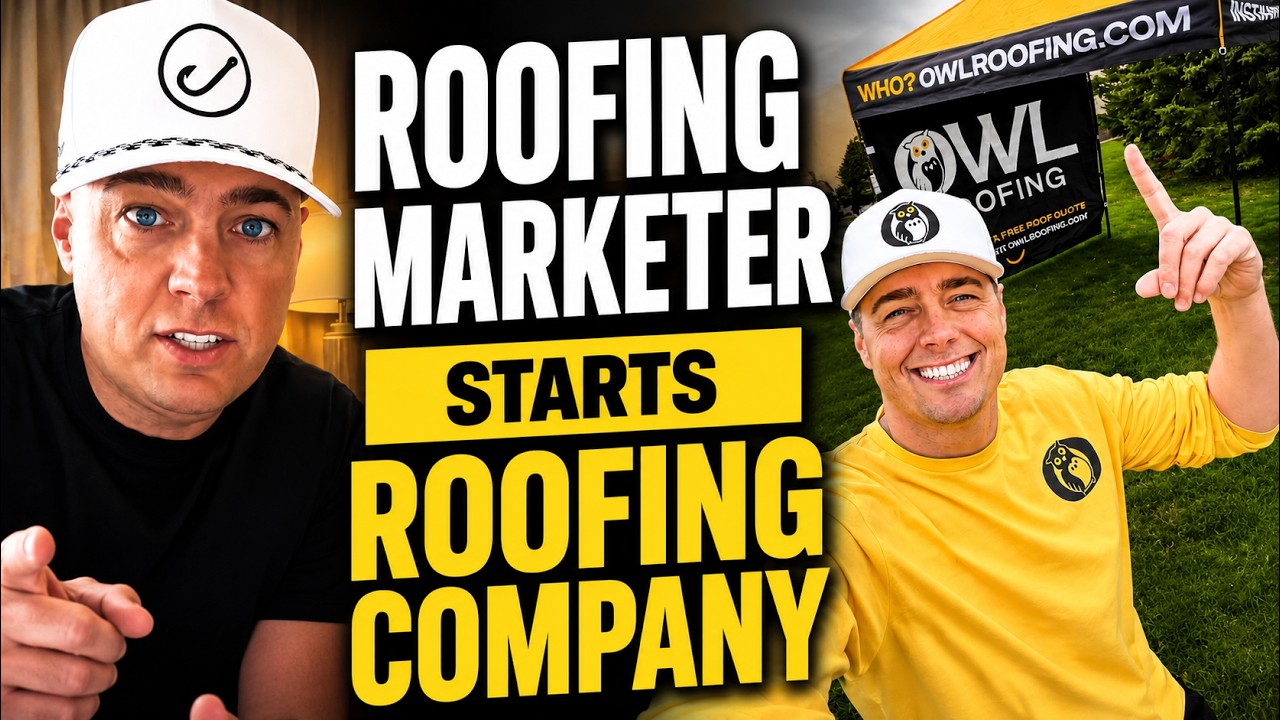
From Roofing Marketer to Roofing Company Owner: Tim Brown’s Strategy for Building Owl Roofing
Tim Brown spent years helping roofing contractors grow through digital marketing at Hook Agency. After working alongside more than 100 roofing companies and spending time on job sites, roofs, and in attics, he made a different kind of commitment: launching Owl Roofing in the Twin Cities.
Starting a roofing company gave Brown the opportunity to test the marketing, sales, customer experience, and local visibility strategies he has recommended to contractors for years. It also reinforced a core lesson for roofing business owners: long-term growth depends on more than leads. It requires simple systems, strong sales execution, dependable production partners, and a customer experience people feel confident referring.
Table of Contents
- Why Tim Brown Started a Roofing Company
- Owl Roofing’s Local, Community-Focused Vision
- Customer Experience Is a Roofing Company’s Real Differentiator
- Marketing a New Roofing Company: Start Narrow and Measure What Works
- Three Roofing Marketing Tactics Brown Is Testing
- SEO and Answer Engine Optimization for Roofing Companies
- Why Roofing Directories Still Matter
- Do Not Overbuy Roofing Software and Tools
- The Hard Part of Moving From Roofing Marketing to Roofing Operations
- Key Lessons for New Roofing Company Owners
- Building a Roofing Company Means Testing Ideas in the Real World
Why Tim Brown Started a Roofing Company
Brown views roofing as a durable business category because homeowners will continue to need roof replacements and repairs. Storm activity can affect demand from year to year, but roofs still wear out, sustain damage, and require professional work.
He also sees an opportunity for operators who understand marketing and sales. Roofing is not only about installing materials. It is also about creating trust during a major home project, communicating clearly, and managing the production process reliably.
Owl Roofing was launched with production-focused partners, while Brown brings marketing, sales, and customer experience expertise to the business. For him, the venture is both a local service company and a practical testing ground for roofing growth strategies.
Owl Roofing’s Local, Community-Focused Vision
The Owl Roofing name is built around the idea of protecting the nest. Brown and his co-founder connected through an early childhood program as they were preparing to have children, and the business reflects a desire to serve the local community where they live and work.
Rather than trying to immediately dominate every market in the Twin Cities, Owl Roofing is intended to develop strong local relationships. Brown’s vision includes helping neighbors, supporting nearby community organizations, and making a meaningful difference in a defined service area.
This local orientation matters because a roofing company’s reputation is built home by home. Every estimate, installation, cleanup, follow-up call, and referral affects how the business is perceived in the neighborhoods it serves.
Customer Experience Is a Roofing Company’s Real Differentiator
Brown believes the roof itself will get installed one way or another. The bigger differentiator is how the homeowner experiences the process.
A strong roofing customer experience means the customer feels informed, connected, and confident about what is happening before, during, and after the project. This is especially important in an industry where subcontractors commonly perform production work and where homeowners may be unfamiliar with the roofing process.
What better customer experience looks like
- Clear communication: Homeowners understand the project timeline, next steps, and who to contact with questions.
- Reliable process control: Checklists and operational systems help ensure important steps are not missed.
- Coordinated production: Subcontractors and crews are managed in a way that keeps the project smooth and predictable.
- Visible accountability: Customers are not left wondering whether their concerns have been received or addressed.
- Thoughtful post-project follow-up: The relationship does not have to end the moment the final shingle is installed.
Brown’s experience listening to roofing sales calls has shown him where communication frequently breaks down. A company can generate demand successfully and still lose business when calls are mishandled, follow-up is slow, or customers receive inconsistent information.
Marketing a New Roofing Company: Start Narrow and Measure What Works
Launching Owl Roofing from scratch has made attribution and lead quality immediate priorities. The arrival of an early lead from an unknown source is exciting, but it also creates an important question: where did the lead come from?
For roofing contractors, attribution does not need to be complicated at first. It does need to be consistent. Each new lead should be tracked by source, including referrals, organic search, paid search, direct mail, door knocking, directory listings, social media, and repeat customers.
A practical lead attribution checklist
- Ask every prospect how they found the company.
- Record the answer in the CRM or lead management process.
- Use unique phone numbers, landing pages, or campaign codes where appropriate.
- Compare booked appointments, sold jobs, and revenue by lead source.
- Review results regularly before expanding a campaign.
Brown’s approach is not to market broadly to every household in a metro area from the beginning. Instead, he is concentrating effort in selected areas with a population of roughly 100,000 people. That focus allows a new contractor to build recognition, improve repeat exposure, and learn which campaigns perform before spreading resources too thin.
Three Roofing Marketing Tactics Brown Is Testing
Brown is combining digital marketing knowledge with practical local tactics. The goal is not to chase every possible channel, but to use a small number of methods with clear intent.
1. An aftercare kit that supports referrals
One approach is an Owl-branded aftercare kit. It includes an extra bundle of shingles for the homeowner to keep, along with a prominent referral reminder offering $250 per referral.
Keeping extra shingles can be useful if a future repair is needed. More importantly from a relationship standpoint, the kit gives the company a useful physical presence in the customer’s garage after the job is complete.
This tactic follows a simple principle: give the homeowner something genuinely helpful, then make the referral opportunity easy to remember.
Contractors interested in the extra-shingle concept can learn more about Shingle Tomb.
2. Targeted bid mailers in chosen neighborhoods
Brown is also using bid mailers to reach homes in focused areas. The concept involves identifying homes in a neighborhood and sending an offer or estimate-oriented mailing to those addresses.
For a roofing company, the value of this tactic is concentration. Instead of sending a small number of mail pieces across an entire metro, a contractor can create repeated awareness in a targeted location.
Direct mail should be treated as a measurable campaign, not a one-time guess. Track the drop area, date, offer, calls, booked appointments, and sold work. That information makes it easier to decide whether to repeat, improve, or stop the campaign.
More information about this approach is available through Bid Mailers.
3. Door knocking alongside digital marketing
Despite his digital marketing background, Brown is not relying solely on digital lead generation in the first year. Owl Roofing also plans to use door knocking.
The lesson is straightforward: roofing marketing does not have to be digital or traditional. A local contractor can use both, especially when campaigns are geographically focused. Digital visibility can establish trust before contact, while field outreach can create conversations in areas where the company wants to build a presence.
SEO and Answer Engine Optimization for Roofing Companies
Brown sees search engine optimization and answer engine optimization, often called AEO, as closely connected. Traditional SEO remains important because many of the same signals that help a company appear in Google search can also support visibility in AI-generated answers and search summaries.
However, AEO creates an additional opportunity for roofing companies to establish their brand in local recommendation-style searches.
How roofing contractors can improve local search visibility
- Create useful local content that clearly identifies the service area.
- Publish list-based content, such as a guide to roofing companies or roofing considerations in a specific city.
- Seek mentions and listings on reputable, relevant websites.
- Build profiles on local and industry-specific directories.
- Keep business information consistent across platforms.
- Continue investing in strong SEO fundamentals rather than treating AI search as a separate shortcut.
Brown’s view is that companies already doing SEO well may be positioned to benefit from AEO, though they should also look for new opportunities to earn brand mentions and relevant list placements on well-ranked sites.
Why Roofing Directories Still Matter
Local and niche directories can help customers find a roofing business while also creating signals that support search visibility. Brown prioritized getting Owl Roofing listed in the local Chamber of Commerce and in industry-specific directories soon after launch.
The most useful directories are relevant to the contractor’s market or trade. A roofing contractor should avoid treating directory listings as a volume exercise. The priority should be accurate, credible placements that make sense for homeowners and for local search.
One industry option is the Roofer’s Helper contractor directory.
Do Not Overbuy Roofing Software and Tools
One of Brown’s clearest cautions for roofing business owners is to keep the operating stack simple. The roofing industry has no shortage of vendors offering software, marketing tools, and services. Yet adding too many platforms can create expense and distraction without improving the core business.
He recommends choosing only a small number of essential tools, then focusing on the fundamentals that actually drive results: leadership and sales.
Questions to ask before adding a new roofing tool
- What specific problem will this solve?
- Who on the team will use it consistently?
- Does it replace another process, or merely add complexity?
- Can its impact on revenue, speed, communication, or operations be measured?
- Would training the sales team or improving follow-up produce a bigger result first?
Technology can support a roofing company, but it cannot replace leadership, sales discipline, customer communication, and production coordination.
The Hard Part of Moving From Roofing Marketing to Roofing Operations
Brown describes starting a business as exciting, but he also acknowledges the difficult conversations involved. Since Hook Agency has worked with roofing contractors in the same market, some existing relationships naturally changed after Owl Roofing launched.
That situation illustrates an important business reality: decisions that are right for one company or family can still affect valued professional relationships. Clear communication and respect are essential when roles, partnerships, or competitive boundaries change.
Brown remains involved with Hook Agency while leadership takes on a larger role in the agency. He sees Owl Roofing as complementary to his marketing work because operating a roofing company creates deeper firsthand understanding of the pressures contractors face.
Key Lessons for New Roofing Company Owners
Brown’s move from marketing provider to roofing company owner offers a useful framework for contractors launching or rebuilding a roofing business.
- Build for the customer experience, not just the install. Communication, clarity, and follow-through influence reputation and referrals.
- Choose a focused local market. Concentrated marketing is easier to measure and can create stronger neighborhood awareness.
- Track every lead source. Do not assume a campaign works without knowing whether it produces appointments and jobs.
- Use referrals intentionally. A helpful post-project item and a clear referral incentive can keep the company top of mind.
- Combine channels intelligently. SEO, AEO, directories, direct mail, and door knocking can support one another.
- Keep operations simple. A short, well-used tool stack is often more effective than a collection of underused software.
- Prioritize sales and leadership. Growth tools matter, but strong people and repeatable sales execution remain central.
Building a Roofing Company Means Testing Ideas in the Real World
For Brown, Owl Roofing is a chance to test proven ideas under real operating conditions. That means managing lead generation, referral systems, sales activity, customer expectations, local reputation, production coordination, and the risk that comes with any new business.
The broader lesson for roofing contractors is not that every company should copy the same tactics. It is that business owners should select a manageable strategy, measure results, refine the customer experience, and stay focused on the few activities that directly move the company forward.
|
Frequently Asked Questions
Why did Tim Brown launch Owl Roofing?
Brown launched Owl Roofing to serve the Twin Cities locally, apply his marketing and sales knowledge, and test roofing growth strategies in an operating company.
What is the main differentiator for a roofing company?
Brown emphasizes customer experience, particularly clear communication, dependable processes, effective production coordination, and a smooth homeowner journey.
Should a new roofing company focus only on digital marketing?
No. Brown is combining digital tactics such as SEO and AEO with local methods including direct mail, referrals, directories, and door knocking.
How can roofing companies improve answer engine visibility?
Useful local content, strong SEO fundamentals, relevant list content, and credible local or industry directory listings can help establish brand visibility.