THE ROOFER'S HELPER QUICK LINKS
JOIN 900K+ ROOFING FANS!
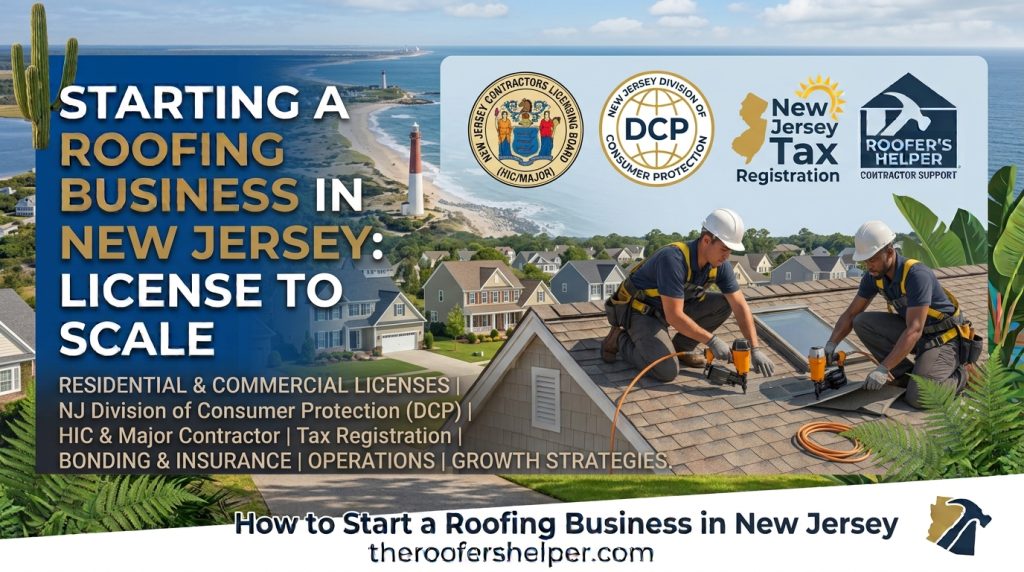
To start a roofing business in New Jersey, you must follow these essential regulatory steps:
- Form Your Business Entity: Register your LLC, Corporation, or Sole Proprietorship with the New Jersey Division of Revenue and Enterprise Services and obtain a Federal EIN.
- Register as a Home Improvement Contractor (HIC): Submit an application to the New Jersey Division of Consumer Affairs (DCA). For any home improvement contract exceeding $500, HIC registration is mandatory (the current biennial fee is $110). New Jersey does not issue a standalone state “roofing trade license.”
- Secure General Liability Insurance: You must submit proof of minimum statutory General Liability Insurance- typically **at least $500,000 per occurrence**- as part of your HIC registration application. Carry trade-specific coverage through specialized providers like Contractors Liability.
- Obtain Workers’ Compensation Insurance: If you employ one or more workers, carrying mandatory New Jersey Workers’ Compensation insurance is required by state law.
- Understand Municipal Permitting: While the state handles HIC registration, actual **construction permits** for roof replacements must be pulled at the municipal level from the local Construction Official before work begins.
New Jersey presents a unique and robust market for roofing contractors, driven by a high-density population, affluent northern counties, and severe weather patterns ranging from coastal nor’easters to heavy winter freeze-thaw cycles. However, the state maintains strict regulations designed to protect consumers under the mandatory Contractor Registration Act.
Operating a roofing company in New Jersey without proper state registration is prosecuted as a criminal misdemeanor and carries severe civil penalties. To build a legitimate and profitable roofing enterprise in the Garden State, you must navigate state business formation, mandatory Department of Law and Public Safety registration, tax accounts, statutory insurance mandates, and local construction codes. This guide provides the complete blueprint from regulatory compliance to field setup.
1. Legal Business Entity Formation
Before soliciting clients or accepting deposits, you must establish a legal business entity in the State of New Jersey to separate personal assets from your commercial roofing liabilities.
- Form an LLC or Corporation: Complete your business entity registration online through the New Jersey Division of Revenue & Enterprise Services (DRES). This establishes your official business record.
- Obtain a Federal EIN: Secure your Employer Identification Number (EIN) instantly and for free from the IRS EIN Application Portal. This number is required for banking and tax purposes.
- Register for New Jersey State Taxes: As a registered NJ business, you must register for state tax obligations, such as Sales and Use Tax (if applicable) and Employer taxes (if hiring employees), through the same NJ DRES portal.
2. Mandatory New Jersey HIC Registration
The state of New Jersey does not issue a specific trade license for roofing. Instead, all contractors performing home improvements on residential properties where the total cost of the work exceeds $500 must register with the **New Jersey Division of Consumer Affairs (DCA)**.
You MUST register as a Home Improvement Contractor (HIC) before you can legally:
- Offer or sell home improvement services (including full roof replacements).
- Use any marketing, business cards, or vehicle signage indicating you are a roofer.
- Accept a contract or deposit from a homeowner.
Key HIC Registration Details:
- Current Registration Fee: $110 (this is a biennial fee, meaning you must renew every two years).
- Required Identification: You must include your FEIN (Federal EIN) or, if a Sole Proprietor with no EIN, your Social Security Number on the application.
- Mandatory Disclosure: Your HIC registration number **must appear on all contracts, proposals, and advertisements**, including website footers and vehicle lettering.
- Renewal: HIC registration typically renews by March 31st of your renewal year. Operating with a lapsed HIC registration renders your contracts legally voidable by the homeowner.
3. Statutory Insurance Requirements
New Jersey construction regulations demand significant financial protection for both the homeowner and your workers. Failure to carry proper coverage will cause your HIC application to be denied or your registration to be revoked.
1. Commercial General Liability Insurance
State statutory mandates require proof of General Liability insurance from a licensed carrier. The baseline minimum typically acceptable for the HIC unit is **$500,000 per occurrence**. Professional NJ roofing companies usually carry policies valued at **$1,000,000 per occurrence** to properly cover the risks of open-roof exposure, height liabilities, and structural damage. Secure specialty trade coverage- ensuring hot-work and height exclusions are removed- directly through Contractors Liability.
2. New Jersey Workers’ Compensation Insurance
Under New Jersey law, all businesses with one or more employees (including part-time or seasonal workers) must maintain Workers’ Compensation insurance. Workers’ Comp is non-negotiable for roofing operations. Verify rules via the NJ Department of Labor and Workforce Development.
4. Understanding Local New Jersey Permitting
HIC registration is a *state-level accountability requirement*, but it does not grant trade competency or universal authority to perform a complex construction task like a full roof tear-off and replacement. New Jersey classifies major roofing work under the **New Jersey Uniform Construction Code (UCC)**.
Key Permitting Rules for NJ Roofers:
- Permits are Local: You must apply for construction permits from the **Municipal Construction Official** of the town where the job is located.
- When is a Permit Required?: A construction permit is generally required for any full roof replacement (tear-off and install), major repair, or structural alteration. Minor patch repairs may sometimes be exempt, but you should always verify with the local construction department first.
- Inspections: All permitted roofing projects require formal inspections by the Municipal Construction Official or a Design Professional (if required by project scope) to ensure the new installation complies with the UCC.
5. Field Operations & CRM Setup
Success in high-margin markets like New Jersey demands organized field logistics and modern administrative software.
Operational Checklist for the Garden State:
- Equipment & Tools: Equip vehicles with proper ladder racks, safety harnesses, and modern roofing tools. Ensure your safety protocols (OSHA tie-offs) are strictly enforced to align with your specialized insurance mandates.
- Supplier Accounts: Establish local credit lines with major New Jersey roofing suppliers (e.g., ABC Supply, QXO, SRS Distribution) with branches positioned to serve both the dense northern and coastal shore regions.
- CRM & Project Management Software: Leverage industry tools- Try JobNimbus for Free to handle digital job estimates, organize pre- and post-inspection photos required for UCC compliance, manage municipal permits, and handle customer invoicing.
6. Marketing & Winning Roofing Contracts in New Jersey
Winning residential and commercial roofing contracts in competitive markets like Bergen, Essex, or Monmouth counties depends heavily on your local reputation and digital visibility.
- Google Business Profile & Reviews: Claim and optimize your Google Business Profile (formerly GMB), explicitly targeting service towns within your region. Build trade authority by soliciting reviews that highlight your specialized services (e.g., storm restoration, severe weather shingle upgrades).
- Niche Market Expansion: Consider specializing in specialized services appropriate for the region, such as durable asphalt shingles built for northern freeze-thaw cycles or silicone roof coating restorations for aged commercial flat roofs. We break this down in our specialized guide on How to Start a Roof Coating Business.
- Marketing Tactics: Explore our resource page for 15 Simple Roofing Marketing Ideas or read our complete national overview on How to Start a Roofing Business to refine your sales pipeline.
Need Help Growth Strategy or Licensing Your Roofing Business?
Building a successful roofing business comes with unique challenges—from state licensing compliance to scaling your sales pipeline. At The Roofer’s Helper, we’re dedicated to helping contractors navigate every step of the journey.
Whether you need assistance finding local industry resources, getting listed in our contractor directory, or exploring trade partnership opportunities, we’re here to help.