THE ROOFER'S HELPER QUICK LINKS
JOIN 900K+ ROOFING FANS!
Overview
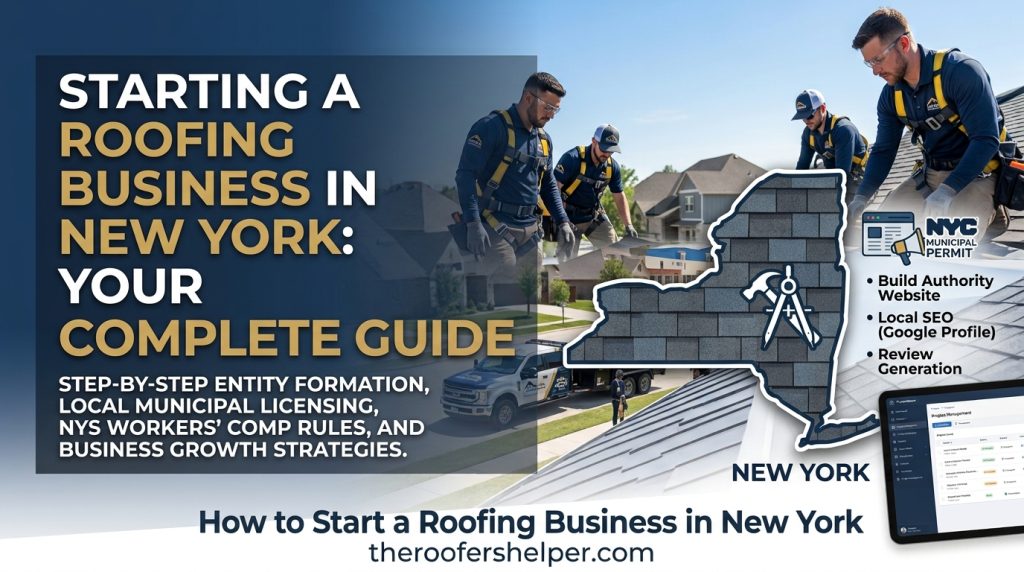
Launching a roofing business in New York State presents an immense financial opportunity. From dense residential neighborhoods across Long Island and the Hudson Valley to commercial flat roofs throughout New York City, Upstate, and Western New York, demand for skilled roofing contractors remains consistently high year-round. Harsh winter freeze-thaw cycles, coastal wind events, and seasonal severe storms generate continuous repair and full replacement work.
However, running a successful roofing enterprise in the Empire State requires navigating a unique regulatory landscape. Unlike states with unified trade licensing boards, New York delegates contractor licensing strictly to local municipalities and counties. Combined with aggressive labor compliance, strict NYS Workers’ Compensation laws, and unique LLC formation rules, launching a roofing business requires a structured, step-by-step approach.
This comprehensive guide details everything you need to legally structure, license, insure, equip, and scale a professional roofing company in New York State.
At a Glance: How to Start a Roofing Business in New York
- Form a Legal Entity: Register a New York LLC or Corporation online via the NYS Department of State (DOS) ($200 filing fee) and fulfill NY LLC newspaper publication requirements.
- Obtain Federal & State Tax IDs: Secure a free FEIN from the IRS and register as a sales tax vendor with the NYS Department of Taxation and Finance.
- Verify Local Municipal Licensing: New York has no statewide roofing license. You must secure home improvement or general contractor licenses at county and city levels (e.g., NYC DOB, Nassau County, Suffolk County, Westchester County).
- Secure Mandated NY Insurance: Obtain Commercial General Liability insurance, mandatory NYS Workers’ Compensation (C-105.2 / U-26.3), and Disability/Paid Family Leave coverage.
- Implement Safety Protocols & Software: Enforce strict OSHA fall protection standards for NY weather conditions and streamline job estimation using a CRM like JobNimbus.
Step 1: Planning & Business Foundation
Laying a clear foundation before taking on your first job site protects your personal wealth, reduces tax liabilities, and gives your enterprise a strong brand identity in competitive markets.
General Business Startup Fundamentals
Before diving into state-specific compliance, it is critical to master core contracting fundamentals, including estimating margins, equipment selection, crew management, and lead generation. For a complete national overview, review our master guide on How to Start a Roofing Business.
Choosing Your Company Name & Branding
Your company name must balance professionalism, memorability, and local search appeal. In New York, your legal name must be distinguishable from all other registered entities on file with the NYS Department of State.
- Name Strategy: Pick a name that conveys reliability, local presence, or superior craftsmanship. Need inspiration? Check out our list of Roofing Business Name Ideas.
- Evaluation Criteria: Learn how to choose a brand that ranks well locally and resonates with homeowners by reading Choosing a Roofing Company Name.
Selecting the Right Business Structure
Choosing the correct legal entity is one of the most critical steps for a high-risk trade like roofing. Operating as an unregistered sole proprietor leaves your personal bank accounts, house, and assets completely exposed to job site injuries or property damage claims.
- Sole Proprietorship: Easiest to set up, but offers zero liability protection. Highly discouraged for roofing contractors.
- Limited Liability Company (LLC): The industry standard for independent roofers. It separates your personal assets from business liabilities and provides flexible pass-through taxation.
- S-Corporation or C-Corporation: Ideal for larger contractors planning to hire multiple sales teams, manage heavy payrolls, or bring on outside investors.
For a detailed comparison of tax advantages and personal asset protection, review our guide on Choosing a Roofing Business Structure.
Step 2: New York Business Entity Registration & Taxes
Once you select a structure, you must officially register your company with state tax authorities and the Department of State.
1. Register Your Legal Structure with NYS DOS
To form an LLC or Corporation in New York, you must file Articles of Organization or Certificate of Incorporation with the NYS Department of State Division of Corporations. The state filing fee for a New York LLC is $200.
2. The New York LLC Newspaper Publication Requirement
Unlike almost any other state, New York strictly enforces Section 206 of the Limited Liability Company Law. Within 120 days of forming your LLC, you must:
- Obtain designated newspaper names from your local County Clerk.
- Publish a copy of your Articles of Organization or a notice of formation in two local newspapers (one weekly, one daily) once a week for six consecutive weeks.
- Obtain Affidavits of Publication from the publishers.
- File a Certificate of Publication with the NYS Department of State along with the $50 state filing fee.
3. File a DBA (Certificate of Assumed Name) if Needed
If your legal LLC name is “Empire Roofing Solutions LLC” but you plan to advertise as “Empire Roof Repair,” you must file a Certificate of Assumed Name with the NYS Department of State. Sole proprietorships must file DBAs directly with their local County Clerk.
4. Federal Employer Identification Number (EIN)
Every contracting business needs a Federal Tax ID to open business checking accounts, hire employees, and apply for local licenses. Apply online for free on the official IRS FEIN Portal.
5. New York State Tax Registration
Roofing services and structural repairs are generally subject to New York State and local sales taxes. You must register as a sales tax vendor and receive a Certificate of Authority from the NYS Department of Taxation and Finance at least 20 days before performing taxable work.
Step 3: New York Licensing & Local Permitting Rules
Understanding licensing in New York requires recognizing that there is **no single statewide roofing license**. Instead, licensing power is entirely decentralized and managed by local municipalities, counties, and towns.
New York City (NYC) Requirements
To operate in the five boroughs of NYC (Manhattan, Brooklyn, Queens, Bronx, Staten Island):
- Home Improvement Contractor (HIC) License: Required by the NYC Department of Consumer and Worker Protection (DCWP) for any residential repair or replacement over $200.
- NYC DOB General Contractor Registration: Required by the NYC Department of Buildings (DOB) to pull structural, commercial, or major alteration permits.
County & Municipal Contractor Licensing
Many major counties across New York enforce mandatory local trade licensing, requiring written exams, background checks, character references, and proof of localized liability insurance:
- Nassau County: Home Improvement Contractor License issued by the Nassau County Office of Consumer Affairs.
- Suffolk County: Home Improvement License issued by the Suffolk County Department of Labor, Licensing & Consumer Affairs.
- Westchester County: Home Improvement License issued by the Westchester County Department of Consumer Protection.
- Rockland County: Contractor License issued by the Rockland County Consumer Protection Board.
- Upstate Cities (Buffalo, Syracuse, Rochester, Yonkers, Albany): Require local contractor registration and specialized building permits prior to commencing tear-offs or structural work.
Step 4: Mandatory New York Insurance & Safety Protocols
New York is widely recognized as one of the most stringent insurance and risk environments for construction trades in the country. Carrying proper policies is vital for protecting your company against catastrophic claims.
Commercial General Liability Insurance
General Liability (GL) covers third-party property damage and bodily injury on job sites. Because roofing involves height exposures and potential water damage, standard policies often contain strict exclusions. Ensure your policy specifically permits height work, open-flame torch-down operations (if applicable), and sub-contractor usage. Obtain tailored quotes through Contractors Liability.
Mandatory NYS Workers’ Compensation Insurance
Under the NYS Workers’ Compensation Board, construction employers must carry Workers’ Comp coverage for all full-time, part-time, and seasonal employees. New York strictly monitors non-compliance: failure to secure coverage results in severe daily monetary fines, stop-work orders, and potential criminal misdemeanor charges. Municipalities will not issue building permits without receiving an official Certificate of Workers’ Comp (Form C-105.2 or U-26.3).
NYS Disability & Paid Family Leave (DB/PFL)
New York law mandates that all eligible employers provide statutory Disability Benefits and Paid Family Leave to cover off-the-job injuries or family care needs.
Federal OSHA Safety & Fall Protection
New York operates under Federal OSHA enforcement. Roofing accounts for a significant portion of construction fall injuries. You must equip all crew members with compliant personal fall arrest systems (PFAS), full-body harnesses, secure anchorage points, and safe ladder tie-offs for any work performed at heights of 6 feet or higher. Review federal mandates on the official OSHA Roofing Safety Page and read our overview on OSHA Roofing Safety Standards.
Step 5: Equipment, Suppliers & Operations
With legal, tax, and insurance requirements established, focus on setting up your operational infrastructure for profitability.
1. Key Roofing Equipment & Vehicles
- Transportation: A reliable heavy-duty pickup truck or box truck equipped with ladder racks.
- Debris Removal: A dedicated dump trailer or established accounts with local roll-off container services.
- Safety Gear: OSHA-approved harnesses, ropes, shock-absorbing lanyards, roof anchors, and hard hats.
- Hand & Power Tools: Pneumatic roofing nailers, air compressors, tear-off shovels, chalk lines, utility knives, and tin snips.
2. Establishing Supplier Accounts
Set up pro commercial accounts with major local and regional roofing supply distributors (such as ABC Supply Co., Beacon Building Products, or SRS Distribution). Establishing credit lines and distributor relationships provides access to competitive material pricing, direct rooftop delivery services, and manufacturer rebate programs.
3. Implementing CRM & Software Systems
Manual paperwork slows down growth. Modern roofing companies rely on dedicated software to handle digital roof measurements, customer communication, instant estimating, and job costing. Organize your entire operational pipeline using JobNimbus Management Software.
Step 6: Marketing & Local Lead Generation in New York
Building a successful roofing business requires a predictable stream of qualified homeowner leads across your target target counties.
1. Optimize Your Google Business Profile & Local SEO
When homeowners search for “roof repair near me” or “best roofer in Westchester,” local search results dominate. Claim your Google Business Profile, upload high-resolution photos of completed projects, fill out all service areas accurately, and implement an automated process to gather five-star customer reviews after every job.
2. Build a Conversion-Focused Website
Your website acts as your 24/7 digital storefront. Ensure it prominently displays your local license numbers, proof of insurance, manufacturer certifications, customer testimonials, and clear contact forms. If you need a professional, high-converting contractor website, contact our team.
3. Proven Marketing Strategies
Combine digital tactics with localized offline efforts. For a complete tactical playbook, read our guide on 15 Simple Roofing Marketing Ideas, which covers canvas techniques, yard signs, storm-chasing strategies, and targeted social media ads.
Need Help Building Your Roofing Business?
Navigating local regulations is just the first step. At The Roofer’s Helper, we provide hands-on guidance to help new and growing contractors master branding, marketing, sales, and ongoing business management. Whether you need a high-converting website, lead generation strategies, or streamlined operational workflows, we’re here to help you build a profitable company.