THE ROOFER'S HELPER QUICK LINKS
JOIN 900K+ ROOFING FANS!
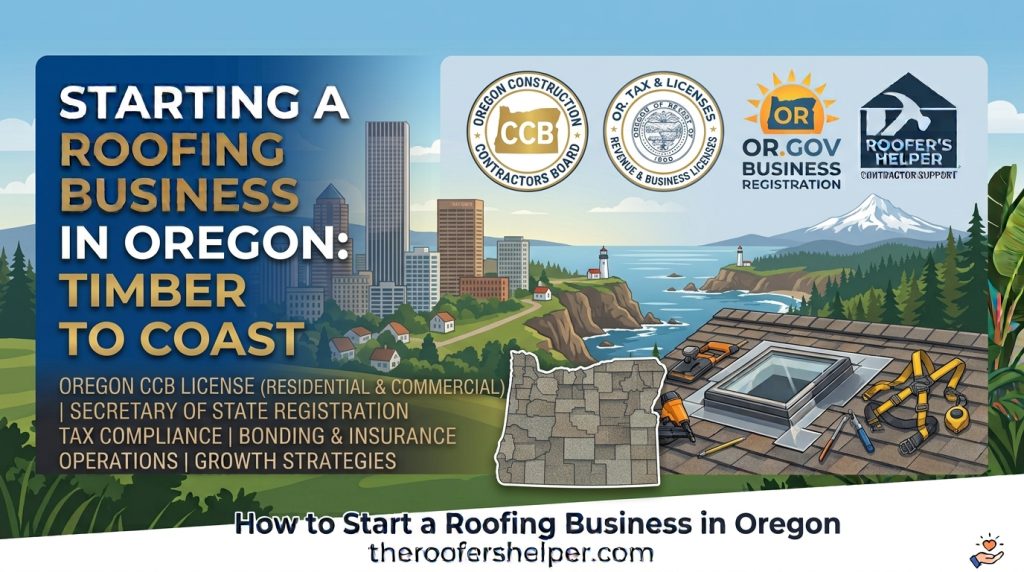
To launch a compliant roofing operation in Oregon, contractors must meet strict state licensing and operational standards:
- Form Your Business & Register SecState: Establish an LLC, Corporation, or Partnership and file with the Oregon Secretary of State Corporation Division. Obtain an EIN from the IRS.
- Appoint a Responsible Managing Individual (RMI): Designate an RMI to complete the mandatory 16-hour pre-license training course through an approved provider and pass the Oregon CCB license exam.
- Secure an Oregon CCB License: Apply for a Construction Contractors Board (CCB) license through the Oregon CCB, choosing a Residential (RGC, RBC) or Commercial (CGC1, CGC2) endorsement structure.
- File Surety Bond & Insurance Documentation: Secure a state-mandated CCB surety bond ($15,000 to $25,000+ depending on endorsement class) and active commercial general liability insurance ($500,000 to $2,000,000 limits).
- Register for Tax Accounts & Workers’ Comp: Open withholding tax accounts with the Oregon Department of Revenue and secure mandatory Workers’ Compensation insurance.
Oregon presents a dynamic roofing market driven by sustained residential growth in the Willamette Valley, heavy commercial demand in the Portland metro, and distinct regional microclimates—ranging from coastal rain belts to central high-desert snowfall. Because of the technical demands of managing Pacific Northwest moisture and wind, the state maintains rigorous contractor oversight administered by the Oregon Construction Contractors Board (CCB).
Performing roofing work in Oregon without an active CCB license is a violation of state law, resulting in civil penalties up to $5,000 per violation, immediate project shut-down orders, and forfeiture of legal rights to file mechanic’s liens or enforce contracts. This step-by-step guide walks you through legal formation, CCB exam qualification, surety bonding, mandatory insurance, municipal permitting, and strategic field operations in Oregon.
1. Legal Entity Formation & Oregon Tax Registration
Before offering roofing estimates or signing client agreements, you must establish a compliant legal entity and register with state tax authorities.
- Secretary of State Business Registration: File your Articles of Organization (LLC) or Articles of Incorporation online through the Oregon Secretary of State Business Registry. Foreign entities must file an Application for Authority.
- Federal EIN Setup: Obtain a Federal Employer Identification Number instantly using the IRS EIN Portal.
- State Department of Revenue Setup: Register through Oregon Revenue Online to set up corporate tax, State Payroll Tax withholding, and local transit or business taxes where applicable. Note that Oregon does not assess a general state sales tax on materials or labor.
2. Oregon CCB Licensing: RMI Exam & Endorsements
Every commercial or residential roofing contractor operating in Oregon must hold an active CCB license tied to a designated Responsible Managing Individual (RMI).
Step 1: RMI Education & Exam
Your designated RMI (an owner, partner, or full-time officer) must complete 16 hours of mandatory pre-license education approved by the CCB. Upon course completion, the RMI must pass the Oregon CCB license exam administered by PSI Services with a score of 70% or higher.
Step 2: Select Endorsement Classification
Oregon classifies CCB licenses based on property type and business scale:
- Residential General Contractor (RGC): Covers all residential structures and small commercial structures. Authorizes roofing subcontracts and prime contracts.
- Residential Building Contractor (RBC): Authorizes work on residential structures under specific cost thresholds.
- Commercial General Contractor (CGC1 or CGC2): Authorizes commercial roofing, industrial construction, and large-scale multi-family projects with varying experience and bond criteria.
Mandatory Contract Inclusion: Oregon state law requires your CCB License Number to appear on all estimates, residential contracts, business cards, print ads, company vehicles, and websites.
3. CCB Surety Bonds & Mandatory Insurance Standards
The Oregon CCB requires proof of continuous financial protection before issuing or renewing any contractor license.
1. CCB Contractor Surety Bond
You must purchase and file an official Oregon CCB Surety Bond in an amount determined by your license classification:
- Residential General Contractor (RGC): $20,000 Surety Bond
- Residential Specialty Contractor: $15,000 Surety Bond
- Commercial General Contractor Level 1 (CGC1): $75,000 Surety Bond
- Commercial General Contractor Level 2 (CGC2): $20,000 Surety Bond
2. Commercial General Liability Insurance
You must maintain liability coverage matching your CCB endorsement tier. Requirements range from $500,000 per occurrence for residential specialty classes to $2,000,000 combined single limit for Level 1 commercial contractors. Secure comprehensive trade coverage through Contractors Liability.
3. Oregon Workers’ Compensation Insurance
Under Oregon law, any employer hiring one or more subject workers—including full-time, part-time, or seasonal roofing crew members—must secure Workers’ Compensation insurance through a authorized commercial carrier or SAIF Corporation. Sole proprietors without employees may apply for subject-worker exemptions.
4. Local Municipal Permitting & Pacific Northwest Building Codes
Holding a CCB license grants authority to contract, but active job sites require local clearance and strict code compliance.
- City & County Permits: Structural alterations, commercial replacements, and residential re-roofing require permits pulled from local building safety departments—such as the City of Portland Bureau of Development Services, City of Eugene Planning & Development, or Salem Building & Safety Division.
- Moisture & Wind Code Standards: Roofing work must comply with the Oregon Residential Specialty Code (ORSC) or Oregon Structural Specialty Code (OSSC). Key technical requirements include continuous ice-and-water shield barriers in high-snow zones, specific continuous ridge ventilation profiles, strict flashing around coastal zones, and low-slope membrane slope rules.
5. Operational Equipment & Field Management Software
Operating a productive roofing business in high-rainfall environments requires specialized field gear and cloud workflow technology.
- Rain-Safe Field Gear: Equip field trucks with waterproof tear-off containment setups, steep-slope fall protection systems, rapid-deployment temporary weatherproofing tarps, and high-altitude pneumatic tools.
- Supply Chain Relationships: Establish commercial credit and delivery schedules with regional building material distributors and local wholesale supply partners across Portland, Eugene, Bend, and Medford.
- Integrated Contractor Operations: Centralize your field photo capture, multi-option proposals, insurance restoration tracking, and customer communications—Try JobNimbus for Free.
6. Strategic Marketing & Client Acquisition in Oregon
Capturing market share across the Pacific Northwest requires a clear digital presence and tailored customer messaging.
- Geotargeted SEO & Regional Portals: Build out targeted local service pages for primary metro areas like Beaverton, Hillsboro, Bend, and Gresham. Display your CCB license number prominently in your website footer and local business listings to build immediate credibility.
- Pacific Northwest Weatherization Messaging: Focus consumer marketing on preventative maintenance, gutter system integration, leak prevention, moss treatments, and high-wind shingle warranties tailored to rainy climate conditions.
- Retail & Restoration Channels: Develop a steady residential retail replacement business while maintaining rapid-response capacity for winter storm damage and high-wind emergency repairs.
- Contractor Resources: Review our trade growth guide covering 15 Simple Roofing Marketing Ideas or check out our master overview on How to Start a Roofing Business.
Ready to Build Your Roofing Business in Oregon?
Navigating CCB licensing exams, RMI designations, surety bonds, and local moisture-control codes requires an organized strategy. At The Roofer’s Helper, we provide practical guides, digital tools, and industry resources to help trade contractors succeed.
Contact us today to explore contractor tools, get featured in our directory, or take your roofing business to the next level.
Get in Touch With Us