THE ROOFER'S HELPER QUICK LINKS
JOIN 900K+ ROOFING FANS!
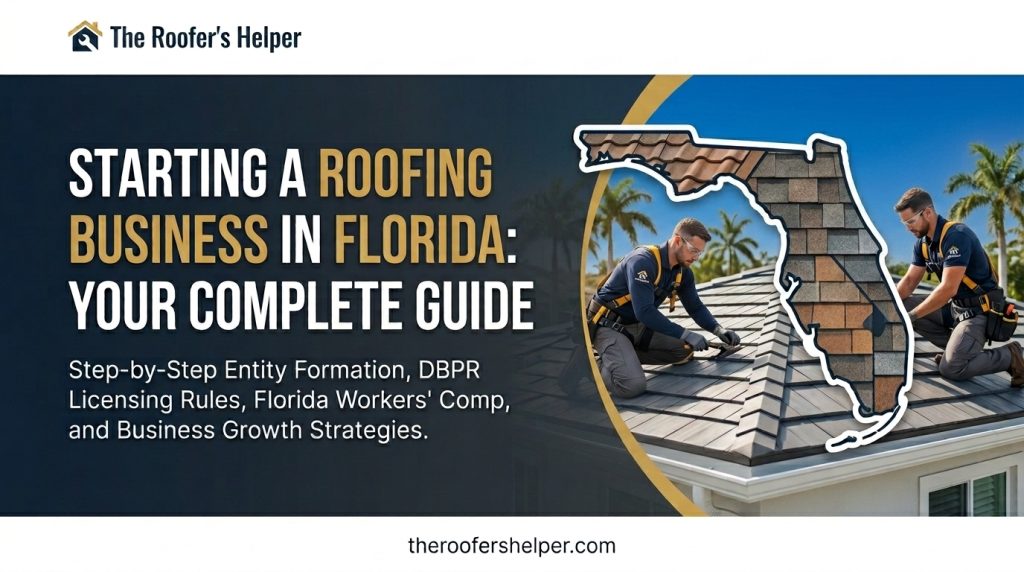
How to Start a Roofing Business in Florida: Complete Contractor Guide
At a Glance: How to Start a Roofing Business in Florida
- Form Your Business Entity: Register a Florida LLC or Corporation online through Sunbiz (Florida Division of Corporations) ($125 filing fee) and obtain a free Federal EIN from the IRS.
- Pass the DBPR Licensing Exam: Pass the Florida Certified Roofing Contractor exam administered by the Florida Construction Industry Licensing Board (CILB).
- Verify Prerequisites & Financial Stability: Provide proof of 4 years of active roofing experience (or equivalent education), a 660+ FICO credit score (or financial stability bond), and net worth requirements.
- Secure Insurance & Workers’ Comp: Obtain Commercial General Liability insurance ($300k+ property damage / $100k+ bodily injury) and mandatory Florida Workers’ Compensation coverage (or file a valid corporate exemption).
- Register for Florida Taxes: Register for a Sales and Use Tax account via the Florida Department of Revenue.
- Deploy Software & Growth Systems: Enforce Florida Building Code (FBC) wind mitigation standards and manage job estimation with contractor CRM tools like JobNimbus.
Overview
Starting a roofing business in Florida puts you directly into one of the largest, highest-demand construction markets in North America. Rapid population growth, frequent tropical storm activity, intense heat, and high-wind events ensure a constant need for residential re-roofs, tile replacements, metal roof conversions, and commercial repairs across the Sunshine State.
However, Florida maintains some of the nation’s strictest contractor licensing, building code compliance, and insurance regulations. Operating legally requires obtaining a state license through the Department of Business and Professional Regulation (DBPR), adhering to stringent Florida Building Code (FBC) standards, and meeting rigorous Workers’ Compensation requirements.
This comprehensive guide details step-by-step how to form, license, insure, and scale a profitable roofing contracting business in Florida.
Step 1: Planning & Business Structure
Laying a clear legal and operational foundation before taking on client projects protects your personal wealth and establishes a professional brand in competitive markets.
General Business Fundamentals
Before completing regulatory filings, it is essential to master trade fundamentals like job costing, material takeoff math, crew management, and lead generation. For a detailed national roadmap, review our core master guide on How to Start a Roofing Business.
Choosing Your Business Name & Branding
Your company name must balance credibility, brand appeal, and local search visibility. In Florida, your business name must be unique and distinguishable from all other registered entities on file with the Division of Corporations.
- Name Ideas: Select a title that reflects quality craftsmanship, storm resistance, or regional trust. Need inspiration? Explore our curated list of Roofing Business Name Ideas.
- Selection Strategy: Learn how to evaluate brand names for long-term SEO and customer perception by reading Choosing a Roofing Company Name.
Selecting Your Legal Entity Structure
Operating as an unregistered sole proprietor leaves your personal bank accounts, home, and personal assets vulnerable to job site liability or injury claims. Choosing a formal business structure insulates you from personal exposure.
- Sole Proprietorship: Minimal initial setup, but leaves your personal assets completely unprotected. Not recommended for high-risk trades.
- Limited Liability Company (LLC): The most popular structure for trade contractors. Provides personal liability protection, administrative simplicity, and flexible pass-through taxation.
- Corporation (S-Corp / C-Corp): Well-suited for larger contracting companies planning to run multi-crew operations, heavy payrolls, or pursue commercial contracts.
For a complete breakdown of asset protection and tax advantages, review our resource on Choosing a Roofing Business Structure.
Step 2: Florida Entity Formation & Tax Setup
Once you select a structure, you must register your enterprise with state authorities prior to conducting business or pulling permits.
1. Register Your Business Entity on Sunbiz
To establish an LLC or Corporation in Florida, submit your Articles of Organization or Articles of Incorporation online through Sunbiz (Florida Division of Corporations). The Florida LLC filing fee is $125.
2. Federal Employer Identification Number (EIN)
An EIN is required to open a business bank account, purchase equipment under company credit, hire workers, and apply for state licensing. Apply online for free via the official IRS FEIN Application Portal.
3. File a Fictitious Name (DBA) if Applicable
If you intend to transact business under a name other than your official legal corporate entity name, file a Fictitious Name Registration through Sunbiz ($50 fee). Florida law requires publishing your fictitious name intention in a local county newspaper prior to registration.
4. Florida State Tax Registration
Register online with the Florida Department of Revenue to establish a Sales and Use Tax account. While labor for real property improvements isn’t always taxed, sales tax rules apply when selling materials or retail services.
Step 3: Florida DBPR Roofing Contractor Licensing
Unlike states with decentralized municipal rules, Florida strictly enforces statewide contractor licensing. Unlicensed roofing is a criminal offense in Florida.
Certified vs. Registered License Types
The Florida Construction Industry Licensing Board (CILB) issues two main categories of roofing licenses:
- Certified Roofing Contractor (CCC): Allows you to contract and perform roofing work anywhere across the entire State of Florida. This is the preferred license for growing businesses.
- Registered Roofing Contractor: Restricts your work strictly to specific local counties or municipalities where your competency credentials have been recognized.
Key Prerequisites for the DBPR License
To qualify for a Certified Roofing Contractor (CCC) license, candidates must fulfill the following requirements:
- Experience: Must demonstrate at least 4 years of active construction experience (or a combination of accredited college engineering/construction coursework and practical field experience), with at least 1 year serving as a foreman or supervisory role on roofing projects.
- CILB Examination: Pass the two-part Florida Roofing Contractor Examination (covering Trade Knowledge and Business & Finance) administered by Professional Testing, Inc. / Pearson VUE.
- Credit & Financial Stability: Demonstrate financial stability by submitting personal credit reports showing a FICO credit score of 660 or higher. If your score is below 660, you must obtain a Florida Financial Stability Bond.
- Background Check: Submit digital fingerprints for a state and national criminal history background check.
Step 4: Mandatory Florida Insurance & Building Code Standards
Due to severe weather risks and coastal hurricane exposures, Florida maintains tight insurance monitoring and building code enforcement.
Commercial General Liability Insurance
Florida DBPR requires Certified Roofing Contractors to maintain minimum general liability coverage levels ($300,000 for property damage and $100,000 for bodily injury). However, most commercial lenders and residential property owners require $1,000,000+ limits. Secure trade-specific policies via Contractors Liability.
Florida Workers’ Compensation Compliance
Under the Florida Division of Workers’ Compensation, construction businesses with one or more employees (including corporate officers or LLC members) are legally required to carry Workers’ Compensation insurance. Corporate officers or LLC members who meet specific ownership criteria may apply for a formal Workers’ Comp Exemption (Form DWC-250), but all non-exempt field workers must be fully covered.
Florida Building Code (FBC) & Wind Resistance
All roofing systems installed in Florida must comply with the current Florida Building Code, which includes stringent requirements for wind resistance, underlayment attachment, secondary water barriers, and High-Velocity Hurricane Zone (HVHZ) product approvals in Miami-Dade and Broward counties. Local municipal building departments strictly enforce permit pulls, mid-roof inspections, and final re-roof affidavits.
Federal OSHA Safety Compliance
Florida roofing job sites are subject to federal safety standards enforced by OSHA. Personal fall arrest systems (PFAS), safety nets, or guardrail systems are mandatory for workers operating at heights of 6 feet or greater. Review safety protocols on the official OSHA Roofing Safety Page and read our overview on OSHA Safety Standards.
Step 5: Operational Infrastructure & Technology
Building a scalable Florida roofing business requires modern management systems to streamline job estimating, material deliveries, and crew tracking.
1. Essential Tools & Vehicles
- Vehicles: Reliable work trucks or dump trucks equipped with heavy-duty ladder racks.
- Safety Equipment: Full-body harnesses, roof anchors, safety ropes, and OSHA-compliant extension ladders.
- Field Tools: Pneumatic coil nailers, air compressors, tear-off pitchforks, magnetic sweepers, and specialized sheet metal tools.
2. Distributor Accounts
Establish commercial accounts with major Florida roofing suppliers (such as ABC Supply Co., Beacon, or Suncoast Roofers Supply). Direct distributor relationships ensure reliable job-site roof loading, access to wind-rated materials, and bulk contractor pricing.
3. Contractor Management Software
Keep your sales funnel, aerial measurements, material orders, and job costing organized in one place. Scale your daily operations efficiently using JobNimbus Management Software.
Step 6: Marketing & Local SEO for Florida Roofers
Winning consistent, high-margin re-roof contracts requires an established digital presence across your target target counties.
1. Google Business Profile & Local Search
When homeowners search for “best roofer near me” or “roof replacement in Tampa,” local map pack rankings drive the majority of calls. Optimize your Google Business Profile with verified license details, service areas, job site photos, and a consistent review-gathering process.
2. High-Converting Website
Your website serves as your digital credential. Display your DBPR license number prominently (required by Florida law on all advertising), showcase before-and-after galleries, list insurance coverage, and include quick quote request forms. Need a custom site tailored for roofing conversion? Contact our team.
3. Marketing Playbook
Combine online strategies with ground-level canvassing in neighborhoods recently impacted by severe weather. Read our strategic guide on 15 Simple Roofing Marketing Ideas to learn proven lead generation techniques.
Need Help Building Your Roofing Business?
Navigating licensing and state regulations is just the first step. At The Roofer’s Helper, we provide hands-on guidance to help new and growing contractors master branding, marketing, sales, and ongoing business management. Whether you need a high-converting website, lead generation strategies, or streamlined operational workflows, we’re here to help you build a profitable company.