THE ROOFER'S HELPER QUICK LINKS
JOIN 900K+ ROOFING FANS!
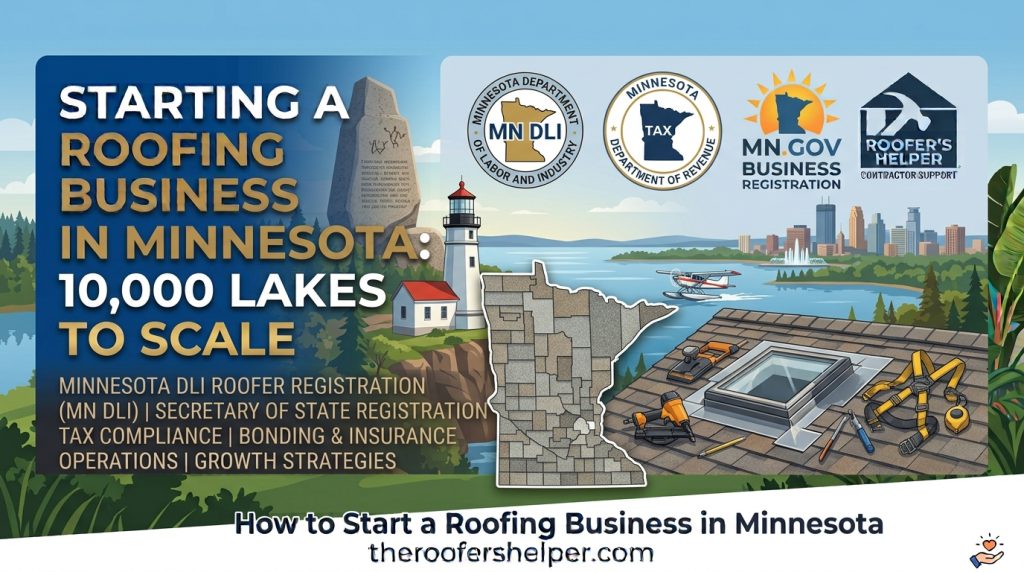
To start a roofing business in Minnesota, you must fulfill key state licensing, tax, and insurance requirements:
- Form Your Business Entity: Register your LLC, Corporation, or Partnership with the Minnesota Secretary of State and obtain a Federal Employer Identification Number (EIN) from the IRS.
- Designate a Qualifying Person & Pass the State Exam: Designate a Qualifying Person (QP) to pass the open-book Qualifying Roofer (QR) or Qualifying Builder (QB) exam administered by the Minnesota Department of Labor and Industry (DLI).
- Obtain a Minnesota DLI License: Apply for a Residential Roofer (RR) license or Residential Building Contractor (BC) license through the Minnesota DLI Construction Codes and Licensing Division. Note that an RR license strictly permits roofing work and excludes gutters, soffits, or fascia installations.
- Post a Surety Bond & Maintain Mandatory Insurance: Secure a $15,000 Minnesota Roofer Surety Bond, maintain Commercial General Liability insurance (minimum $100,000/$300,000 limit), and provide proof of statutory Workers’ Compensation insurance.
- Register for Minnesota State Tax Accounts: Register via Minnesota e-Services through the Department of Revenue to collect and remit state sales tax.
Minnesota offers a highly lucrative environment for residential and commercial roofing contractors. Subject to harsh freeze-thaw cycles, heavy winter snow loads, severe ice damming, and seasonal severe hail storms across the Twin Cities metro, Duluth, and Greater Minnesota, structural demand for re-roofing and restoration work remains constantly elevated. However, operating a roofing business in the Gopher State requires navigating state-mandated licensing governed by the Minnesota Department of Labor and Industry (DLI).
Executing residential roofing work without an active Minnesota DLI license or valid exemption is a misdemeanor carrying administrative fines, stop-work orders, and loss of legal rights to enforce customer contracts or file mechanic’s liens. This comprehensive step-by-step blueprint walks you through legal formation, DLI qualification exams, bonding, statutory insurance, local code compliance, and scaling operations in Minnesota.
1. Business Entity Formation & Minnesota Tax Setup
Before marketing roofing services or bidding on contracts, establish a formal legal entity to protect personal assets from operational liabilities.
- Register Entity with the Secretary of State: File your Articles of Organization (LLC) or Articles of Incorporation online through the Minnesota Secretary of State Business Portal.
- Obtain a Federal EIN: Secure your Employer Identification Number instantly for free from the IRS EIN Portal.
- Register with Minnesota Revenue: Set up state tax accounts for Sales & Use Tax collection and employer tax withholding via Minnesota e-Services.
2. Minnesota DLI License Requirements (RR vs. BC Credentials)
The Minnesota Department of Labor and Industry (DLI) regulates all residential roofing work on 1-to-4 family structures. Contractors must choose the appropriate license category based on their operational scope.
Understanding License Classifications:
- Residential Roofer (RR) License: Authorizes work strictly limited to roof coverings, sheathing, weatherproofing, insulation, and repair of existing roof systems. Critical Distinction: An RR licensee cannot legally contract for or install gutters, downspouts, soffits, or fascia.
- Residential Building Contractor (BC) License: Authorizes full residential construction, exterior remodeling, roof replacements, and exterior envelope components (including gutters, soffits, and siding) on both new construction and existing homes.
Steps to Obtain Your License:
- Designate a Qualifying Person (QP): Assign an owner, officer, or managing employee to serve as the Qualifying Person for the company.
- Pass the DLI Examination: The QP must sit for and pass the open-book Qualifying Roofer (QR) or Qualifying Builder (QB) exam with a score of 70% or higher.
- Submit the Application: Complete the DLI licensing application through the iMS online management system, pay the $180 application fee, and provide background disclosures.
3. Surety Bonds & Statutory Insurance Mandates
Minnesota enforces specific financial protection requirements to safeguard property owners against trade default or property damage.
1. Minnesota Roofer Surety Bond
Roofing contractors holding a Residential Roofer license must post a $15,000 Surety Bond with the DLI to guarantee compliance with state building codes and statutory obligations.
2. Commercial General Liability Insurance
State law mandates minimum liability limits of $100,000 per occurrence, $300,000 aggregate, and $25,000 property damage. However, standard commercial contracts and property managers typically require carrying a $1,000,000 per occurrence / $2,000,000 aggregate policy. Secure customized coverage designed for high-slope exposures through Contractors Liability.
3. Minnesota Workers’ Compensation Insurance
Under Minnesota law, any construction enterprise employing one or more workers (including full-time, part-time, or seasonal crews) must carry statutory Workers’ Compensation insurance. Sole proprietors without employees may elect exemption subject to statutory requirements.
4. Local Building Permits & Cold-Climate Building Codes
A state license authorizes your business to operate, but individual projects require local municipal clearance and strict adherence to structural codes.
- Municipal Permitting: Full roof tear-offs and structural repairs require building permits pulled from local building safety departments—such as the City of Minneapolis Development Services, City of St. Paul Building Inspection Division, or City of Rochester—prior to starting work.
- Ice Dam & Snow Load Standards: Work must comply with the Minnesota State Residential Code (based on the International Residential Code). Municipalities enforce strict regulations regarding ice barrier underlayment extends, attic insulation R-values, and proper roof-ventilation ratios to prevent catastrophic winter ice damming.
5. Operational Equipment & Field Logistics
Operating efficiently across Minnesota requires cold-weather gear, dependable field equipment, and automated workflow management software.
- Cold-Weather Field Gear: Equip field trucks with cold-weather pneumatic nailers, heavy-duty tear-off equipment, ladder hoists, and winter-rated safety harnesses designed for steep frozen surfaces.
- Wholesale Supply Networks: Establish commercial lines of credit with local building material distributors and wholesale supply partners positioned across the Twin Cities, St. Cloud, and Duluth regions.
- CRM & Cloud Management: Streamline multi-option estimating, digital photo inspections, storm restoration supplements, and job tracking—Try JobNimbus for Free.
6. Targeted Marketing & Client Acquisition Strategies
Capturing market share across Minneapolis, St. Paul, and surrounding suburban corridors requires an authoritative local marketing footprint.
- Local Search Optimization: Build out target location pages for primary municipalities (e.g., Edina, Plymouth, Woodbury, Maple Grove). Display your active Minnesota DLI license number prominently on your website and Google Business Profile to prove legal compliance.
- Educational Ice Dam Content: Establish consumer trust by producing educational guides and video content addressing seasonal roof maintenance, proper insulation, and ice dam removal solutions before winter hits.
- Storm Restoration & Retail Channels: Construct a operational model capable of deploying rapidly during seasonal hail storms while building a steady retail re-roofing pipeline through local homeowner referrals.
- Growth Playbooks: Explore our actionable guide on 15 Simple Roofing Marketing Ideas or check out our primary guide on How to Start a Roofing Business.
Need Help Launching or Scaling Your Roofing Business?
Navigating Minnesota DLI licensing requirements, surety bonding, and regional winter building standards can be challenging. At The Roofer’s Helper, we provide practical guides, digital tools, and community support to help trade contractors grow safely and profitably.
Contact us today to explore contractor resources, get listed in our directory, or learn more about building your enterprise.