THE ROOFER'S HELPER QUICK LINKS
JOIN 900K+ ROOFING FANS!
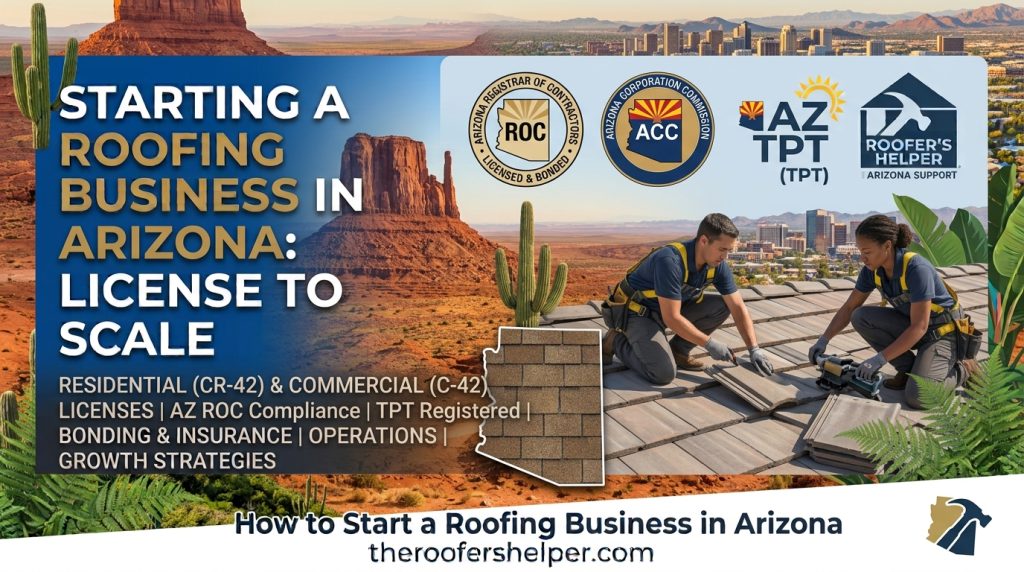
To start a roofing business in Arizona, follow these essential steps:
- Select a Licensing Classification: Choose between a Residential (CR-42), Commercial (C-42), or Dual (K-42) Roofing Contractor License through the Arizona Registrar of Contractors (ROC).
- Form Your Business Entity & Register Name: Register an LLC or Corporation via the Arizona Corporation Commission (ACC), or file a Trade Name with the Arizona Secretary of State.
- Appoint a Qualifying Party & Pass Exams: Designate a Qualifier with at least 4 years of verifiable experience to pass the AZ Statutes & Rules Exam (SRE) and the trade-specific roofing exam.
- Post Required Contractor Surety Bond & Insurance: Secure an Arizona ROC surety bond (typically ranging from $2,500 to $100,000+ based on projected volume) and obtain General Liability and Workers’ Compensation insurance.
- Register for AZ TPT & Set Up Operations: Obtain an Arizona Transaction Privilege Tax (TPT) License via AZTaxes.gov, and deploy field software like JobNimbus to manage local permits, bids, and roof inspections.
Starting a roofing business in Arizona offers massive revenue potential driven by monsoon storm repair, intense heat tile degradation, and continuous Sun Belt population expansion. However, unlike states with decentralized municipal rules, **Arizona strictly enforces state-level contractor licensing for all projects valued over $1,000**.
Operating without a license in Arizona carries severe legal and financial penalties. To build a compliant, high-margin roofing company in Arizona, you must satisfy the Arizona Registrar of Contractors (ROC), secure proper bonding, set up state tax accounts, and establish strong field operations. This guide provides the complete playbook to get licensed and launched.
1. Choose Your Arizona ROC License Classification
In Arizona, roofing is regulated as a specialized trade under the Arizona Registrar of Contractors (ROC). You must choose the classification that matches your intended market:
- CR-42 (Residential Roofing): Allows installation, repair, and waterproofing of roofs on single-family homes, townhouses, and residential structures.
- C-42 (Commercial Roofing): Permits roofing, waterproofing, and insulation installation on commercial, industrial, and multi-family structures.
- K-42 (Dual License – Residential & Commercial): The most versatile option for contractors who want the flexibility to handle both residential roof replacements and commercial flat/foam roofs.
2. Form Your Legal Business Entity in Arizona
Before submitting your application to the ROC, you must establish a legal business entity to protect your personal assets from job site liabilities and storm-restoration claims:
- Form an LLC or Corporation: Submit Articles of Organization or Incorporation through the Arizona Corporation Commission (ACC) eCorp Portal. Note that Arizona requires newly formed entities to publish a notice of filing in an approved county newspaper unless located in Maricopa or Pima County.
- Register a Trade Name / DBA: If operating under a trade name different from your official legal entity, register it with the Arizona Secretary of State.
- Obtain an Federal EIN: Get a free Employer Identification Number online through the IRS EIN Application Portal.
- Apply for an Arizona TPT License: Contractors in Arizona must register for a Transaction Privilege Tax (TPT) license with the Arizona Department of Revenue (ADOR) to legally conduct business and remit tax.
3. Assign a Qualifying Party & Pass State Licensing Exams
The Arizona ROC requires every licensed business to designate a **Qualifying Party** who holds the necessary trade experience and passes required examinations:
- Verifiable Experience Requirement: The qualifying party must demonstrate a minimum of 4 years of journeyman-level experience in roofing.
- Pass the Arizona SRE Exam: The qualifier must pass the computer-based Arizona Statutes and Rules Training Course & Exam (SRE), which covers state construction laws, safety, and business operations.
- Pass the Roofing Trade Exam: The qualifier must pass the C-42/CR-42 trade exam covering tile, shingle, foam, single-ply membranes, and underlayment specifications.
- Fingerprint Clearance: All officers, directors, partners, and qualifying parties listed on the ROC application must submit a fingerprint background check.
4. Secure Arizona ROC Bonding & Trade Insurance
Arizona contractor licensing guidelines mandate financial protection for property owners prior to license issuance:
1. Arizona ROC Surety Bond
Every contractor must post an ROC Surety Bond. The bond amount is calculated based on your estimated annual gross volume for the state:
- Residential (CR-42): Bond amounts range from $4,250 to $100,000 depending on projected gross revenue. Residential contractors must also contribute to the ROC Consumer Recovery Fund or post a second bond.
- Commercial (C-42): Bond amounts range from $5,000 up to $100,000+ based on commercial volume.
2. Insurance Requirements
- Commercial General Liability: Crucial for protecting your business against open-roof rain damage during monsoon season and structural liability. Get specialized policy coverage through Contractors Liability.
- Workers’ Compensation Insurance: Arizona law mandates Workers’ Comp coverage for all employers with one or more employees (including full-time, part-time, and seasonal roofers). Review compliance guidelines via the Industrial Commission of Arizona (ICA).
5. Field Operations & Local Permitting Setup
Running a successful roofing business in Phoenix, Tucson, Mesa, or Flagstaff requires strict local compliance and fast field execution.
Essential Field Checklist:
- Work trucks equipped with ladder racks, tie-downs, and high-temp safety gear
- OSHA-compliant fall protection harnesses, anchors, and heat safety monitoring protocols
- Trade tools for tile replacement, foam spray systems, torch-down, and shingle installations
- Commercial distributor credit lines with local Arizona supply houses
Automate Your Roofing Business with a CRM
In high-volume markets, organized job tracking is critical. You can Try JobNimbus for Free to manage aerial roof measurements, generate digital estimates on site, organize roof inspection photos, and coordinate local municipal permits.
6. Marketing & Winning Roofing Contracts in Arizona
Arizona’s climate presents distinct roofing opportunities—from emergency hail and monsoon response in Maricopa County to flat roof thermal restoration in summer heat.
- Optimize Local Google Search & GMB: Set up and optimize your Google Business Profile explicitly targeting key service regions (e.g., Phoenix, Scottsdale, East Valley, Tucson). Display your ROC license number on your profile, vehicles, and website as required by state law.
- Monsoon & Storm Marketing: Build direct-to-consumer canvassing teams and digital landing pages targeting storm-damaged neighborhoods following severe weather events.
- Emphasize Tile & Foam Specialization: Highlight expertise in tile underlayment replacement (R&R) and polyurethane foam restoration, as these are two of the most requested residential and commercial services in Arizona.
- Explore Master Resources: Read our national overview on How to Start a Roofing Business or check out 15 Simple Roofing Marketing Ideas to expand your brand’s reach.
Need Help Growing or Licensing Your Roofing Business?
Building a successful roofing business comes with unique challenges—from state licensing compliance to scaling your sales pipeline. At The Roofer’s Helper, we’re dedicated to helping contractors navigate every step of the journey.
Whether you need assistance finding local industry resources, getting listed in our contractor directory, or exploring trade partnership opportunities, we’re here to help.