THE ROOFER'S HELPER QUICK LINKS
JOIN 900K+ ROOFING FANS!
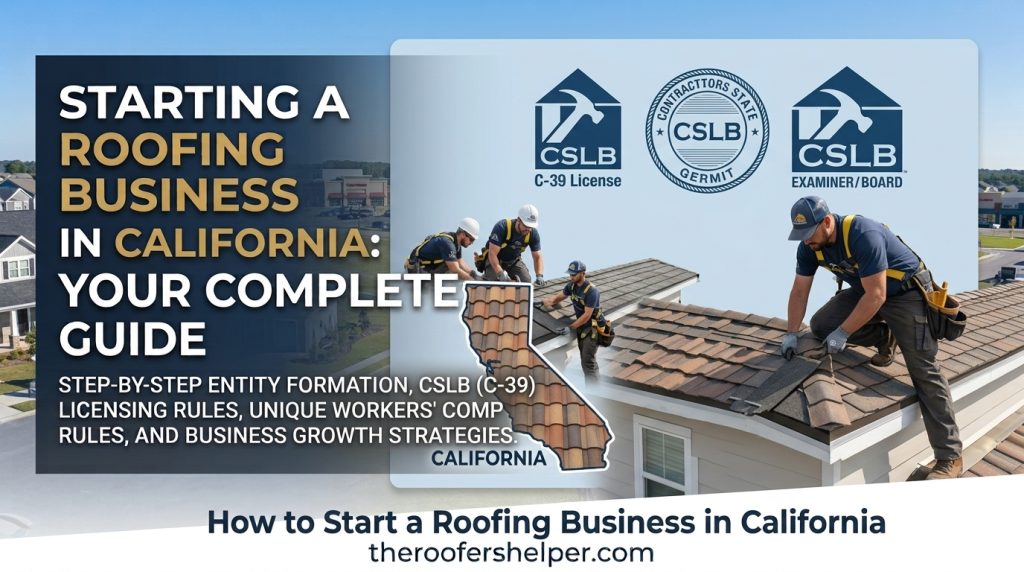
At a Glance: How to Start a Roofing Business in California
- Form Your Business Entity: Register a California LLC or Corporation via the California Secretary of State (bizfile Online) and secure a free FEIN from the IRS.
- Verify CSLB C-39 Eligibility: Ensure your Qualifying Individual has 4 years of documented journey-level roofing experience within the last 10 years.
- Pass CSLB Exams & Background Check: Submit your CSLB Application ($450 fee), complete Live Scan fingerprinting, and pass both the Law & Business and the C-39 Roofing Trade examinations.
- Post Required Surety Bonds: File a mandatory **$25,000 Contractor’s Bond** with the CSLB (plus a $100,000 LLC Employee/Worker Bond if operating as an LLC).
- Secure Mandatory Workers’ Comp & Insurance: Obtain California Workers’ Compensation (mandatory for ALL C-39 licensees, even sole owners with zero employees) and General Liability insurance.
- Comply with Title 24 & Local Business Taxes: Register with the CDTFA for sales/use tax, secure city business licenses, and comply with California Title 24 Cool Roof requirements.
Overview
Starting a roofing business in California provides access to one of the largest construction markets in the world. From high-end residential tile roofs in Southern California to commercial flat-roof retrofits and wild-fire resilient assemblies throughout Northern California, contractor demand remains exceptionally high.
However, California enforces some of the strict contracting regulations in the nation. Any roofing project valued at **$500 or more** (combined labor and materials) legally requires a **Class C-39 Roofing Contractor License** issued by the **Contractors State License Board (CSLB)**. Furthermore, California law treats roofing as a high-risk trade, enforcing strict bond requirements and mandatory Workers’ Compensation rules regardless of payroll size.
This comprehensive guide details step-by-step how to legally form, license through the CSLB, bond, insure, and scale a profitable roofing business in California.
Step 1: Planning & Business Foundation
Establishing a strong operational foundation is critical before navigating California’s rigorous licensing system.
General Business Fundamentals
Before filing state applications, ensure you understand basic trade economics, material estimating math, overhead margins, and field management. For a broader national overview, review our master guide on How to Start a Roofing Business.
Selecting Your Business Name & Branding
Your business name must align with your legal entity filings and pass CSLB naming requirements (the name must directly reflect your license classification and cannot be misleading).
- Name Ideas: Explore creative options with our list of Roofing Business Name Ideas.
- Selection Strategy: Learn how to brand your company for local search authority by reading Choosing a Roofing Company Name.
Choosing the Right Legal Structure
California recognizes several business structures for contractors, each with distinct tax implications and asset protection levels:
- Sole Proprietorship: Simple to establish, but leaves personal assets completely exposed to job site liabilities or injury lawsuits.
- Limited Liability Company (LLC): Popular for asset protection, but carries additional CSLB bonding requirements ($100,000 employee bond) and minimum annual state franchise tax fees ($800).
- Corporation (C-Corp / S-Corp): Ideal for growing contracting firms that intend to hire multiple crews or offer stock equity to key partners.
For a complete breakdown of asset protection and business entities, see our guide on Choosing a Roofing Business Structure.
Step 2: California Entity Formation & Tax Registration
Before applying for your CSLB C-39 license, establish your legal company structure and tax profiles.
1. Register Your Legal Entity with the California SOS
If forming an LLC or Corporation, file your Articles of Organization or Incorporation via the California Secretary of State (bizfile Online) portal ($70 state filing fee for LLCs).
2. Obtain a Federal EIN
Every commercial entity requires a Federal Employer Identification Number to set up business bank accounts, secure distributor credit, and file CSLB paperwork. Apply online for free at the Official IRS FEIN Portal.
3. File a Fictitious Business Name (FBN) / DBA
If operating under a business name other than your legal corporate entity name or individual surname, file a Fictitious Business Name statement with the County Clerk in the primary county where your business operates, followed by mandatory newspaper publication.
4. Register with California Tax Agencies
- Sales & Use Tax: Register with the California Department of Tax and Fee Administration (CDTFA) for a Seller’s Permit or Use Tax Account.
- Payroll Tax: Register with the California Employment Development Department (EDD) to obtain an employer tax account number if hiring employees.
- Local Municipal Licenses: Obtain a Business License / Tax Certificate from every California city or municipality in which you physically perform roofing work.
Step 3: CSLB C-39 Roofing License Requirements
In California, specialty roofing work is governed exclusively by the **Contractors State License Board (CSLB)** under the Department of Consumer Affairs.
1. Experience Requirements
The CSLB requires your Qualifying Individual (either yourself or an appointed Responsible Managing Employee/Officer) to prove at least 4 years of journey-level roofing experience within the last 10 years. Experience must be verified by a licensed contractor, foreman, building inspector, or union representative.
2. The CSLB Application & Background Check
- Submit the *Application for Original Contractor License* along with the mandatory $450 application fee.
- Undergo mandatory Live Scan fingerprinting for criminal background checks conducted by the California Department of Justice (DOJ) and FBI.
3. CSLB Examinations
Applicants must pass two computerized multiple-choice examinations administered at CSLB test centers:
- Law & Business Examination: Covers California employment law, contract requirements, lien laws, safety rules, and business management.
- C-39 Roofing Trade Examination: Covers steep and low-slope roofing systems, estimating, underlayments, flashing, waterproofing, and OSHA height safety.
| CSLB Requirement | Sole Proprietorship / Corp | Limited Liability Company (LLC) |
|---|---|---|
| Application Fee | $450 | $450 |
| Initial License Fee (2 Yrs) | $200 (Sole) / $350 (Corp) | $350 |
| Mandatory Contractor Bond | $25,000 Contractor Bond | $25,000 Contractor Bond |
| Additional LLC Worker Bond | N/A | $100,000 LLC Employee/Worker Bond |
Step 4: Mandatory Bonds, Insurance & Title 24 Compliance
California CSLB Surety Bonds
To activate an initial C-39 license, you must file a **$25,000 Contractor’s Bond** issued by a licensed California surety company. If your business is organized as an LLC, CSLB requires an additional **$100,000 LLC Employee/Worker Bond** to cover potential wage claims.
Strict Workers’ Compensation Mandate for Roofers
Under California Insurance Code and CSLB rules, **all C-39 Roofing Contractors must carry Workers’ Compensation insurance**, even if the business is a sole owner with zero employees. Unlike other construction trades, C-39 licensees cannot file an exemption certificate. Review official rules via the California Division of Workers’ Compensation (DWC).
Commercial General Liability Insurance
Protect your enterprise from job-site structural damage, drop-fault claims, and water leaks during tear-offs by maintaining comprehensive General Liability insurance ($1,000,000+ policy recommended). Secure commercial contractor policies through Contractors Liability.
California Energy Code (Title 24 “Cool Roof” Rules)
California enforces strict energy efficiency standards under **Title 24, Part 6**. Roof replacements and new construction projects across designated climate zones must meet specific solar reflectance and thermal emittance values (“Cool Roof” products certified by the Cool Roof Rating Council). Ensure all product callouts meet local climate zone codes before pulling permits.
Step 5: Equipment, Suppliers & Operations
1. Field Equipment & Transport
- Vehicles: Work-ready heavy-duty trucks fitted with ladder racks, safety equipment boxes, and tie-down points.
- Safety Gear: Cal/OSHA-approved full-body harnesses, roof anchors, lifelines, and safety netting for steep-slope tear-offs.
- Trade Tools: Pneumatic roof nailers, compressors, generator sets, tear-off shovels, and seam-welding equipment for flat single-ply membranes.
2. Distributor Relationships
Establish trade accounts with major California roofing suppliers (such as ABC Supply Co., Beacon Building Products, or Elite Roofing Supply). Direct distributor accounts provide job-site rooftop material loading, bulk contractor pricing, and manufacturer certification paths (e.g., GAF, Owens Corning, CertainTeed).
3. Operations & CRM Software
Streamline your business workflows, digital roof measurements, subcontracts, and customer billing. Organize your administrative and field pipelines using JobNimbus Management Software.
Step 6: Marketing & Local SEO Strategy for California Roofers
1. Google Business Profile & Local Search
California homeowners rely heavily on local search maps when selecting contractors. Claim your Google Business Profile, list your active CSLB C-39 license number (mandatory under California advertising law B&P Code §7027), and establish automated review generation systems.
2. High-Converting Website
Ensure your digital presence clearly communicates trust, proof of insurance, and license credentials. Include customer project galleries, clear call-to-action forms, and license verifications. If you need a high-converting contractor website built, Contact our team.
3. Local Marketing Execution
Combine digital search visibility with direct-mail campaigns, localized job site signage, and direct homeowner outreach after severe weather events. Learn proven customer acquisition tactics in our guide to 15 Simple Roofing Marketing Ideas.
Need Help Building Your Roofing Business?
Navigating CSLB regulations, bonding, and Title 24 rules can be complex. At The Roofer’s Helper, we provide practical guidance to help new and established contractors master branding, digital marketing, lead generation, and business systems. Whether you need an authority website or marketing automation, we’re here to help.