To launch a successful residential roof coating business, follow these core steps:
- Form Your Business Legal Structure: Register a Limited Liability Company (LLC) with your Secretary of State and secure a free Federal EIN from the IRS.
- Obtain Trade Insurance & Licenses: Secure specialty contractor general liability insurance (ensuring thermal/hot-work and spray drift coverage where applicable) via Contractors Liability and satisfy local roofing contractor licensing mandates.
- Match Equipment to Your Coating Specialty: Acquire hand tools (notched squeegees, heavy nap rollers, roof brushes) for entry setups, or invest in commercial rigs (airless sprayers, heated kettles, or 2K proportioners) for high-volume production.
- Secure Manufacturer Certifications: Complete accreditation programs with major coating manufacturers to issue valid 10- to 20-year labor and material warranties.
- Deploy Contractor Management Software: Implement field software like JobNimbus to organize job estimates, roof condition photos, and customer billing.
Residential roof coatings represent one of the fastest-growing sectors in residential and light-commercial exterior maintenance. Homeowners and property managers are increasingly turning to restorative coating systems to extend roof lifespans at a fraction of full tear-off replacement costs. With flexible entry tiers—ranging from low-overhead manual application to high-production commercial spraying—starting a dedicated roof coating enterprise offers outstanding profit margins.
This comprehensive guide breaks down the core chemistry options, minimal and commercial equipment requirements, legal steps, insurance needs, and growth tactics to launch your business.
1. Business Entity Formation & Licensing
Establishing a solid legal foundation insulates your personal finances from chemical overspray claims, ladder liabilities, hot-work hazards, or business debt:
- Form an LLC: Register a Limited Liability Company (LLC) or S-Corporation through your state’s Secretary of State office to separate personal assets from commercial operational risks.
- Secure an IRS EIN: Apply for a free Employer Identification Number (EIN) on the official IRS website to set up business checking accounts and manage payroll.
- Verify Local Roofing & Specialty Licenses: State regulations vary. Determine whether your jurisdiction requires a full specialty roofing contractor license or a specialty painting/restoration credential prior to bidding jobs.
- Register for State & Local Taxes: Acquire state sales tax permits where applicable and register for local municipal business permits.
2. Overview of Roof Coating Systems & Chemistry
Understanding which chemistry fits each substrate is critical for long-term performance and manufacturer warranty compliance:
Acrylic Coatings (Water-Based)
Widely used for sloped metal roofs and asphalt shingles. Acrylics offer great UV resistance, reflectivity, and easy water cleanup. They perform best in high-sun environments with good drainage, but are vulnerable to ponding water and freezing temperatures during application.
Silicone Coatings (Solvent or High-Solids)
The premium choice for flat and low-slope roofs (such as modified bitumen, EPDM, TPO, or low-pitch shingle transitions). Silicone resists permanent ponding water without breaking down, offering high solar reflectance and long-term elasticity.
Polyurethane & Polyurea Coatings
Highly durable, impact-resistant chemistries ideal for areas subject to foot traffic or hail. Polyurethanes provide superior adhesion and tear resistance, available as single-part moisture-cure formulas or two-component (2K) fast-set systems.
Cold-Applied Asphalt Coatings & Emulsions
Cost-effective, solvent-based or water-emulsified asphalt cutbacks used for sealing and restoring built-up roofs (BUR), smooth cap sheets, and metal. These self-healing coatings provide thick waterproofing barriers without requiring open flames on site.
Hot-Applied Asphalt (Hot Kettles / Mop Grade)
Traditional oxidized asphalt melted on-site for heavy-duty waterproofing interply applications and commercial restoration. Requires specialized thermal safety protocols, high heat handling, and fire prevention measures.
SEBS & Rubberized Elastomerics
Solvent-based synthetic rubber coatings offering extreme elongation and immediate rain performance. Excellent for metal roof seams, gutters, and cold-weather applications where water-based acrylics cannot cure.
3. Equipment Requirements: Minimal vs. Commercial Setups
You can launch a coating business with a modest hand-tool budget or invest immediately in high-production commercial machinery. Match your gear to your target application method and coating type:
| Coating Type | Minimal Setup (Hand Application) | Commercial Setup (High-Production) |
|---|---|---|
| Acrylics & Elastomerics | Deep-nap rollers (3/4″ to 1-1/4″), heavy-duty paint frames, 18″ roof brushes, extension poles, paint trays/buckets. | High-output gas airless sprayers (3,000+ PSI, 1.2+ GPM flow rate), heavy fluid hoses, reversible spray tips (.027–.039). |
| Silicone Coatings | Squeegees (flat & notched), heavy-nap solvent-resistant rollers, specialized aggressive roof brooms. | Direct-immersion hydraulic airless spray rigs (e.g., Graco GH 833 / King series), moisture-lock hoses, high-pressure spray guns. |
| Polyurethanes & 2K Fast-Set | Manual notched squeegees, heavy nap rollers, mixing paddles, variable-speed heavy-duty drills. | Heated multi-component proportioner rigs (e.g., Reactor units), heated hose bundles, self-cleaning purge spray guns. |
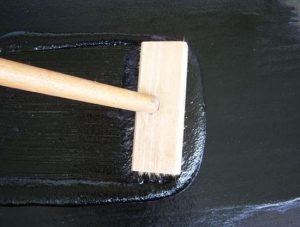
| Cold Asphalt & Emulsions | Coarse fiber roof brushes, heavy notched squeegees, application mops, asphalt dip buckets. | Heavy-duty gas airless sprayers rated for filled mastic materials, fluid transfer pumps, broad-orifice spray tips. |
| Hot-Applied Asphalt | High-temp cotton roof mops, metal pour cans, insulated carrying buckets, metal safety squeegees. | Trailer-mounted gas hot-asphalt kettles, thermostatic burners, mechanical asphalt pumps, insulated piping systems. |
Universal Safety & Site Prep Gear (Required for All Setups):
- Commercial gas pressure washer (3,500+ PSI / 4.0+ GPM) for deep surface preparation
- OSHA-compliant personal fall arrest systems (PFAS), harnesses, roof anchors, and lifelines
- Site masking materials: heavy plastic sheeting, painter’s tape, wind guard screens (to prevent vehicle spray drift)
- Personal Protective Equipment (PPE): organic vapor respirators, eye protection, chemical-resistant gloves, and thermal boots for hot work
4. Specialty Insurance & Environmental Safety
Roof coating applications involve working at heights, high-pressure fluid lines, and chemical chemistry (or open heating for hot asphalt). Proper insurance coverage is essential protection.
General Liability & Workers’ Compensation
Standard general liability policies often contain chemical spray drift, hot-work, or height exclusions. Secure specialized trade coverage directly through Contractors Liability to ensure full protection against overspray, roof leak claims, thermal hazard liabilities, and property damage. If hiring workers, carry state-mandated Workers’ Compensation insurance.
Overspray Mitigation & Safety Standards
- Maintain strict site masking protocols to prevent spray overspray on neighboring vehicles, siding, and landscaping.
- Enforce OSHA fall-protection mandates, including full harness tie-offs, ladder stabilizers, and perimeter warnings.
- Keep Safety Data Sheets (SDS) for all silicone, solvent, acrylic, and asphalt products accessible on every job site.
5. Field Operations & CRM Management
Systemizing your estimating, site inspections, and client communication ensures consistent service delivery as job volume grows.
Standard Operating Workflow:
- Substrate & Moisture Inspection: Conduct thorough inspections (using core cuts or infrared scanners) to detect wet insulation, structural rot, or loose shingles before applying coatings.
- Surface Preparation: Power wash dirt, patch seams, seal fasteners with reinforcement fabric/mastic, and prime the substrate per chemical manufacturer specs.
- Application & DFT Measurement: Apply coatings at specified wet-film thickness (WFT) using wet-film gauges to guarantee required dry-film thickness (DFT) for warranty compliance.
To keep operations running smoothly, you can Try JobNimbus for Free to log inspection photos, deliver digital estimates on-site, track crew schedules, and handle customer billing seamlessly.
6. Marketing & Business Growth Strategies
Build a reliable pipeline of residential and light commercial coating projects by demonstrating clear ROI over full roof replacement:
- Optimize Google Business Profile: Claim and optimize your local search profile. Highlight specialized coating services and publish before-and-after transformation photos of restored roofs.
- Educational Content Marketing: Publish clear breakdown guides showing homeowners how silicone and acrylic coatings lower cooling bills and delay expensive tear-offs.
- Real Estate & HOA Partnerships: Build relationships with real estate agents, property managers, and HOA boards seeking affordable curb-appeal and waterproofing solutions.
- Explore Master Resources: Return to our master guide on How to Start a Roofing Business or read 15 Simple Roofing Marketing Ideas for proven local sales strategies.
How to Start a Roofing Business in the United States
Alabama
Alaska
Arizona
Arkansas
California
Colorado
Connecticut
Delaware
Florida
Georgia
Hawaii
Idaho
Illinois
Indiana
Iowa
Kansas
Kentucky
Louisiana
Maine
Maryland
Massachusetts
Michigan
Minnesota
Mississippi
Missouri
Montana
Nebraska
Nevada
New Hampshire
New Jersey
New Mexico
New York
North Carolina
North Dakota
Ohio
Oklahoma
Oregon
Pennsylvania
Rhode Island
South Carolina
South Dakota
Tennessee
Texas
Utah
Vermont
Virginia
Washington
West Virginia
Wisconsin
Wyoming